property valuation methods Australia
Understanding Property Valuation Methods in Australia: How Your Home's Value Is Determined

Most property owners walk into the selling process with a figure in their head. Sometimes that figure is based on what their neighbour got two years ago. Sometimes it comes from an online estimate tool. Occasionally it is pure gut feeling shaped by how much they love the home they have built their life in. The problem is that overestimating your property's value leads to a stale listing, price reductions, and buyers who wonder what is wrong with the place. Underestimating it means leaving real money on the table. Either way, the cost of not understanding how property valuation actually works is significant.
I have been doing this long enough to know that the sellers who get the best results are not necessarily the ones with the best properties. They are the ones who understand what drives value, know the difference between a formal valuation and an agent's market appraisal, and use that knowledge to position themselves strategically before they go to market. That is not insider knowledge reserved for developers and investors. It is something every homeowner deserves to have access to before they make one of the biggest financial decisions of their life.
This guide covers everything you need to know about property valuation methods in Australia. We go through the three core valuation approaches used by registered valuers, explain what separates a sworn valuation from an agent market appraisal, detail what bank valuers actually look for, and give you a clear process for preparing your property so it presents at its absolute best. Whether you are selling, refinancing, settling an estate, or simply want to understand what you own, this is the resource that cuts through the noise.
Key Takeaways
- A sworn (formal) valuation is a legally defensible opinion of value prepared by a registered valuer. An agent market appraisal is a sales tool and does not carry legal weight, but a well-researched appraisal from a knowledgeable local agent is still enormously useful for setting your price guide.
- The three main approaches to property valuation in Australia are the direct comparison method (comparative market analysis), the income capitalisation approach, and the summation (cost) approach. Most residential valuations rely primarily on direct comparison.
- Banks almost always commission their own valuation, which can differ from what you or your agent believe the property is worth. Knowing why that gap exists, and how to respond to it, can make or break a sale.
- Location, land size, building condition, zoning, recent comparable sales, and the current state of the market all influence value. Renovations can add value, but only if they align with what buyers in that specific suburb actually want.
- You do not have to accept a low valuation passively. There are structured steps you can take to review, challenge, or work around a figure that does not reflect the market.
- Getting a market appraisal before you commit to a sale strategy gives you data-driven pricing confidence and helps you focus any pre-sale improvement spend where it actually counts.
Summary Table: Types of Property Valuations in Australia
| Valuation Type | Who Prepares It | Typical Cost | Legal Standing | Primary Purpose |
|---|---|---|---|---|
| Sworn (formal) valuation | Registered valuer (API member or equivalent) | $300 to $600+ for residential | Legally defensible, admissible in court | Mortgage security, family law, deceased estates, capital gains tax, stamp duty disputes |
| Bank (mortgage) valuation | Registered valuer commissioned by the lender | Usually absorbed into loan costs or $200 to $400 | Binding for lending purposes | Determines how much the bank will lend against the property |
| Agent market appraisal | Licensed real estate agent | Free in most cases | No legal standing | Setting a price guide for sale, understanding current market value |
| Kerbside (desktop) valuation | Registered valuer or data analyst | $100 to $250 | Limited legal standing | Quick indicative figure for low-risk lending decisions |
| Automated valuation model (AVM) | Algorithm (CoreLogic, PropTrack, etc.) | Free to low cost | No legal standing | General market awareness, not suitable for formal purposes |
What Is a Property Valuation?
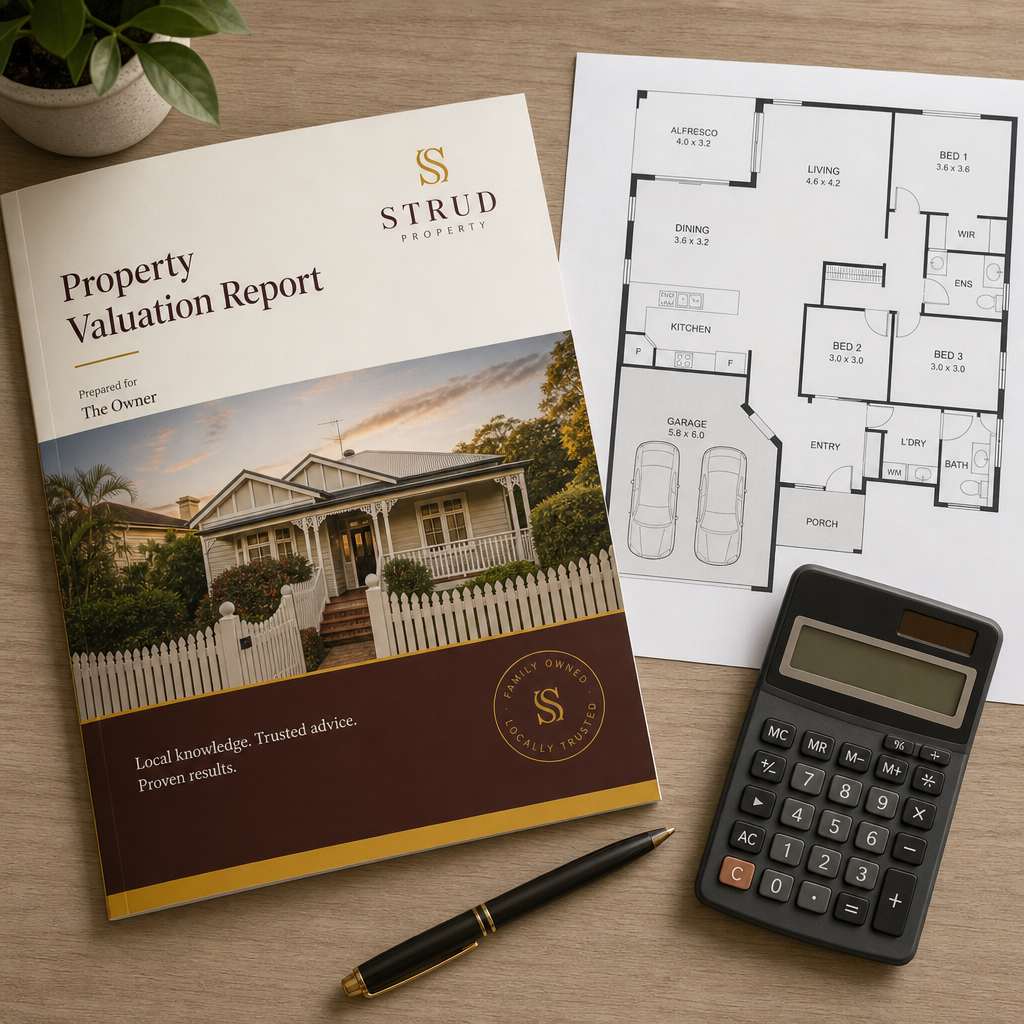
A property valuation is a formal or informal opinion of the market value of a property at a specific point in time. That definition sounds simple, but the process behind it is anything but. Valuation is both a science and an art. It draws on transactional data, physical inspection, market knowledge, zoning rules, and professional judgement to arrive at a figure that represents what a willing buyer would pay to a willing seller in an open and competitive market, with neither party under duress.
In Australia, the concept of "market value" is defined by the International Valuation Standards and adopted by the Australian Property Institute (API), which is the peak professional body for property valuers in this country. The definition essentially requires that both buyer and seller are reasonably informed, acting in their own interests, and that the transaction takes place after adequate time in the market. That sounds like a reasonable set of conditions, but it is worth noting that real-world sales frequently deviate from it. Mortgagee-in-possession sales, deceased estate auctions, and off-market transactions often reflect conditions that sit outside this definition, which is one reason why formal valuations look at a range of evidence rather than relying on any single comparable sale.
The distinction between a formal valuation and a general price estimate matters enormously depending on what you are trying to do with the number. For most sellers, a well-researched market appraisal from a local agent who genuinely knows the area is the right starting point. But there are specific situations where only a sworn valuation will do, and confusing the two can create real problems down the line.
The Legal Framework Behind Property Valuation in Australia
Property valuation in Australia is governed at both state and federal levels. Registered valuers must hold the relevant qualifications and, in most states and territories, hold a valuer's licence issued by the state government. In Queensland, for example, valuers are regulated under the Valuers Registration Act 1992. The API's Professional Practice Standards set out the ethical and technical requirements that members must follow.
The Australian Valuation Standards are informed by the International Valuation Standards (IVS) published by the International Valuation Standards Council (IVSC). Australia's API has worked to align local practice with these international standards, which matters when you are dealing with cross-border transactions, institutional-grade assets, or any situation where your valuation might be scrutinised by a court or a regulator.
For residential property owners, the practical implication is this: if you are relying on a figure for any purpose that has legal or financial consequences, such as a court proceeding, a loan application, a tax matter, or an estate distribution, you need a sworn valuation from a registered professional. A printed email from your real estate agent will not cut it.
Online Estimates and Automated Valuation Models
Platforms like CoreLogic, PropTrack (which powers REA Group), and Domain's automated tools generate estimated values using algorithms that process comparable sales, suburb median data, listing history, property attributes, and in some cases satellite imagery. These tools have improved significantly over the past decade and can be useful for a general sense of where the market sits.
But they have well-documented limitations. They cannot see inside your property. They do not know that you have just spent $80,000 on a kitchen and bathroom renovation, or that the house next door is a rental that has not been maintained in years. They struggle with properties that lack close comparables, such as acreage, prestige homes, or properties with unusual configurations. CoreLogic itself notes that its AVM confidence intervals widen significantly for properties outside the mainstream residential market.
For a seller trying to establish a realistic price guide, an AVM is a starting point for a conversation, not the conclusion of one.
Sworn Valuation vs Agent Market Appraisal
This is the comparison that confuses more people than almost any other in real estate. The two documents can look similar on the surface. Both result in a number. Both involve someone inspecting your property and consulting market data. But they are fundamentally different in purpose, methodology, legal standing, and cost.
What Is a Sworn Valuation?
A sworn valuation, also called a formal valuation or certified valuation, is a written report prepared by a registered valuer. The valuer physically inspects the property, measures the land and improvements, photographs the condition of the building, researches recent comparable sales, considers the zoning and planning overlays, and applies one or more recognised valuation methodologies to arrive at an opinion of value. The report is signed and dated, and the valuer is professionally and legally accountable for the opinion expressed in it.
Sworn valuations are required for:
- Mortgage applications, where the lender needs to establish the security value of the property
- Family law proceedings, where assets must be valued for property settlement
- Deceased estate administration and probate
- Capital gains tax calculations, particularly for pre-CGT property or when establishing a market value cost base
- Stamp duty disputes
- Compulsory acquisition by government
- Legal disputes between parties where property value is at issue
- Self-managed superannuation fund (SMSF) property acquisitions, which the ATO requires to be supported by independent market value evidence
A sworn valuation for a standard residential property in South East Queensland typically costs between $300 and $600. Larger, more complex, or rural properties can cost considerably more. The valuer's fee is separate from the real estate agent's commission and is not contingent on any sale proceeding.
What Is an Agent Market Appraisal?
A market appraisal is an opinion of the likely selling price of a property, prepared by a licensed real estate agent. It is based on the agent's knowledge of recent comparable sales, current market conditions, and their assessment of the property's features, condition, and appeal to likely buyers. A good agent will support their appraisal with evidence: a written report showing recent comparable sales, median price trends for the suburb, days on market data, and an honest assessment of where your property sits within the current market.
A market appraisal carries no legal weight. It is not a valuation in the formal sense of the word, and in most states the agent is required to make that clear to you. Under Australian Consumer Law, an agent who provides a false or misleading appraisal to secure a listing can face consequences from fair trading regulators, but the appraisal itself is still a commercial opinion rather than a certified professional assessment.
That said, do not dismiss the value of a well-researched market appraisal from an agent who genuinely knows their local market. The best agents bring recent, hyperlocal sales data, buyer feedback from active inspections, and practical insights about what is and is not working in the current market. That intelligence is often more current and more directly relevant to your situation than a formal valuation completed weeks earlier.
At George & Sons, our market appraisals are backed by current comparable sales data and honest advice about what the market will actually pay, not what you want to hear.
The Price Gap Problem
One of the most common problems I see is what I call the price gap problem. A seller gets an agent's market appraisal, which comes in high because the agent wants the listing. The seller lists at that price. Six weeks later, the property is still sitting, the price has been reduced twice, and buyers are asking what is wrong with it. The seller ends up achieving less than they would have if they had listed at the right price from day one.
The answer is not to always favour a formal valuation over an agent appraisal. It is to choose an agent who will give you an honest appraisal rather than a flattering one, and then to understand the data well enough to have an informed conversation about it.
The Three Core Valuation Methods Explained
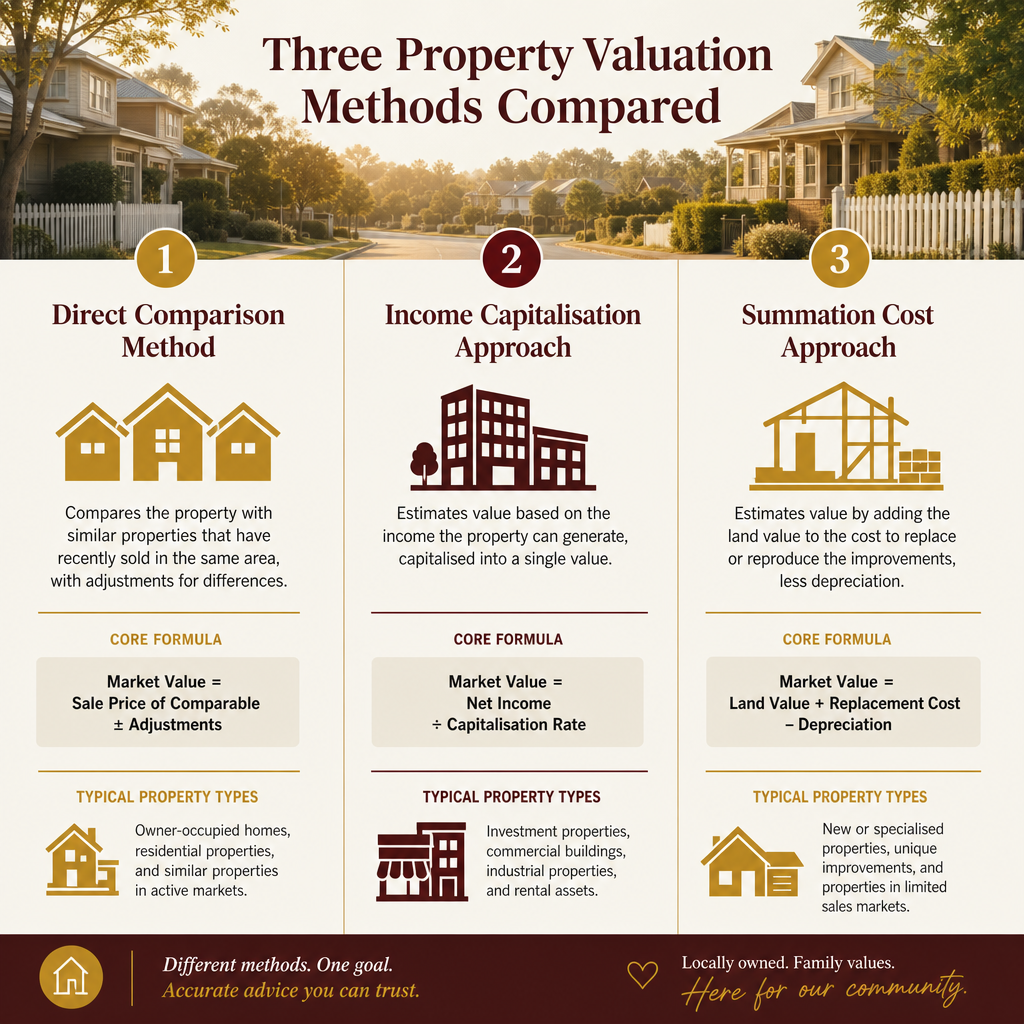
Registered valuers in Australia use three primary methodologies, individually or in combination, depending on the property type, available data, and the purpose of the valuation. Understanding these methods helps you understand why valuers arrive at the figures they do, and what evidence you can provide to support a higher value.
1. The Direct Comparison Method (Comparative Market Analysis)
The direct comparison method is the most commonly used approach for residential property valuation in Australia. It is also the foundation of what real estate agents call a comparative market analysis (CMA). The core principle is straightforward: the value of a property is best estimated by reference to the recent sale prices of genuinely comparable properties in the same or similar market.
The key word is "comparable." A valuer looking at a three-bedroom house on a 600 square metre block in a given suburb will search for sales of similar properties within a defined geographic and time radius. In a liquid suburban market, that might mean sales within the same suburb over the past three to six months. In a thinner market, such as rural areas or prestige precincts, the search radius and time window may need to expand.
Once the valuer has identified a pool of comparable sales, they make adjustments for the differences between each comparable and the subject property. If a comparable sold for $750,000 but had a second bathroom that the subject property lacks, a downward adjustment is made. If the subject property has a larger land area, an upward adjustment applies. These adjustments are based on market evidence where possible, and on professional judgement where direct evidence is limited.
For sellers, the direct comparison method means that the market is not comparing your home to what you paid for it or what you have spent on it. It is comparing your home to what other similar properties have sold for recently. That is why understanding recent local sales data before you go to market is so important.
2. The Income Capitalisation Approach
The income capitalisation approach is used primarily for income-producing properties: residential investment properties where rental data is reliable, and commercial properties where the income stream is the primary driver of value. It is less commonly applied to owner-occupied residential property unless a rental income comparison is needed.
The method works by estimating the net annual income a property generates or could generate, then applying a capitalisation rate (cap rate) that reflects the risk and return profile of that type of property in that market. The formula is:
Value = Net Annual Income / Capitalisation Rate
So a residential investment property generating $30,000 per year in net rent, valued at a cap rate of 4%, would produce an indicated value of $750,000.
The cap rate is the critical variable and is derived from market evidence. In practice, valuers look at what investors have actually paid for similar properties relative to the income those properties produce. Cap rates vary significantly between property types, locations, and market conditions. In a low interest rate environment, cap rates compress as investors accept lower yields. As interest rates rise, cap rates tend to expand, which exerts downward pressure on values.
For landlords and investors, understanding capitalisation rates matters when assessing whether a purchase price reflects fair value and when projecting how changes in interest rates or rental income might affect their asset's value.
3. The Summation (Cost) Approach
The summation approach, also called the cost approach, values a property by adding the current market value of the land to the depreciated replacement cost of the improvements (the buildings and structures on the land). The formula is:
Value = Land Value + Depreciated Replacement Cost of Improvements
Land value is typically estimated using the direct comparison method for vacant land sales. The replacement cost of improvements is calculated by estimating what it would cost to reconstruct the building to the same standard at current prices, then deducting depreciation for physical deterioration, functional obsolescence, and external obsolescence.
The summation approach is most useful when direct comparable sales are limited, such as for specialised properties, new constructions, heritage properties, or large rural holdings. It is also used to cross-check values arrived at through other methods.
For homeowners considering renovations, the summation approach provides a useful lens. If the depreciated replacement cost of your improvements significantly exceeds what comparable sales suggest those improvements are worth in the current market, you may be over-capitalising. The market does not always reimburse you dollar-for-dollar for what you spend on a property.
Which Method Is Used for Your Home?
For most residential properties in metropolitan and suburban Australia, the direct comparison method is the primary approach. Valuers may use the summation approach as a cross-check, particularly for newer properties. The income approach may be applied as a secondary check for investment properties.
A competent valuer uses the method most appropriate to the evidence available and the property type, and explains their methodology clearly in the valuation report. If you receive a valuation report and the methodology is not clearly explained, that is a red flag.
What Affects Your Property's Value?
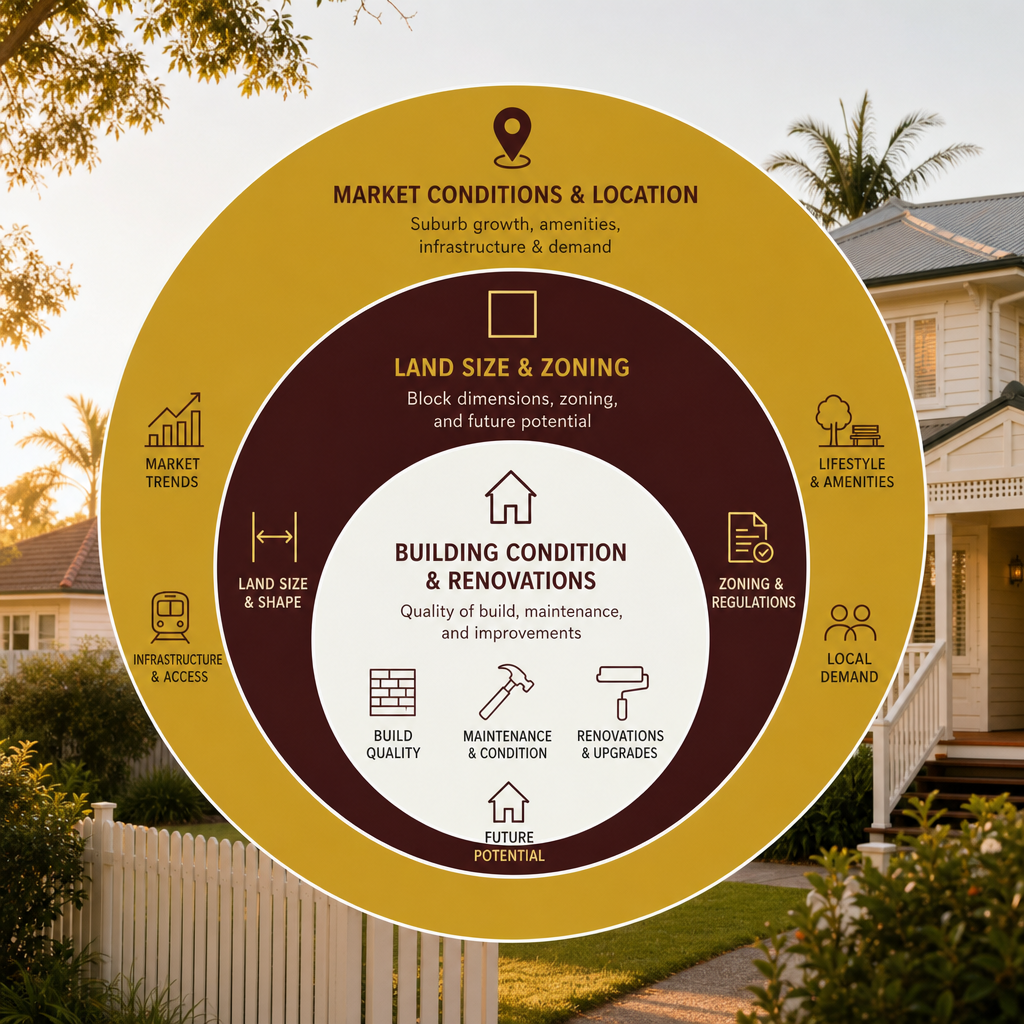
Understanding the factors that drive property value gives you control over the ones you can influence and realistic expectations about the ones you cannot. Valuers and agents consider a layered set of factors, from the broad market environment down to the specific condition of your gutters.
Location: The Factor You Cannot Change
Every experienced agent and valuer will tell you that location is the single most powerful determinant of property value, and they are right. But location is not just about which suburb you are in. It is a layered concept that operates at multiple scales simultaneously.
At the macro level, location determines access to employment centres, infrastructure quality, and economic fundamentals. Properties within practical commuting distance of Brisbane's CBD, for example, carry a persistent premium over equivalent properties further afield. The ABS's Census data consistently shows the relationship between proximity to major employment nodes and property prices.
At the micro level, location determines which specific street, which side of the road, which aspect the house faces, and whether you back onto a reserve or a commercial car park. Two houses in the same suburb, a street apart, can differ in value by 10% to 20% or more based purely on micro-location factors: school catchment, proximity to parkland, distance from a busy arterial road, or flood risk.
In South East Queensland, flood overlays have become an increasingly significant value factor following recent weather events. A property inside a defined flood overlay will often carry a discount relative to an otherwise equivalent property outside it, even if it has never actually flooded. Buyers and their lenders are increasingly aware of these risks, and valuers must account for them.
Land Size and Configuration
In most Australian markets, land is the primary store of value, and the improvements (the house) are the secondary consideration. Land is scarce and essentially irreproducible. Buildings depreciate. A larger land holding in a desirable location will generally hold and grow its value more reliably than a smaller one.
But size alone is not the only consideration. Configuration matters. An irregular block, a narrow frontage, a steep slope, or a shape that limits future development potential will all be reflected in value. A rectangular 600m2 block with a wide frontage in a suburb zoned for low-to-medium density residential is worth more than an equivalent area block with a difficult shape and no development upside.
Zoning is a critical overlay. Properties with medium density or commercial zoning, or that are situated in an area identified for future rezoning, can carry a significant premium over their immediate residential use suggests. Conversely, a restrictive heritage overlay can limit what you can do with a property and affect its value in either direction depending on the market and the buyer profile.
Building Condition and Age
The condition of the improvements has a direct and measurable impact on value. A property in excellent condition, well-maintained and presented, will achieve a premium over a comparable property in poor condition. But the quantum of that premium is not always what sellers expect.
Building age, in isolation, is less important than condition. A well-maintained 1970s home can easily outperform a poorly maintained home built in 2010. What matters is the effective age, which is the condition the property presents in relative to its chronological age. A valuer will assess the building's condition across multiple dimensions: structural integrity, roof condition, electrical and plumbing systems, flooring, fixtures and fittings, and the general state of maintenance.
Pest and building inspections are a useful proxy for a valuer's condition assessment. If a pre-sale inspection reveals significant defects, those defects will likely be reflected in both the valuation and the buyer's offer. Addressing identifiable defects before going to market is almost always worthwhile.
Renovations: When They Add Value and When They Do Not
This is the question I get asked more than almost any other. Renovations can absolutely add value, but they do not always add more value than they cost, and some renovations add very little value at all. The determining factor is whether the renovation aligns with what buyers in your specific suburb and price bracket actually want and expect.
Kitchens and bathrooms consistently return strong value in renovation investment, but only to the extent that the market supports it. If comparable sales in your area are averaging $650,000 and you install a $60,000 European appliance kitchen, the market may simply not reimburse you for that expenditure. Buyers at $650,000 in that suburb are not expecting a $60,000 kitchen. You need to renovate to the standard of the market, not above it.
Conversely, cosmetic improvements such as fresh paint, updated flooring, new light fittings, and landscaping can have an outsized impact on presentation and buyer perception relative to their cost. These improvements do not necessarily change the structural value of the property, but they affect how buyers feel about it, which directly influences how much they are willing to pay.
Additions that genuinely add functional living space, such as a second bathroom, an additional bedroom, or a functional outdoor entertaining area in a climate where outdoor living is valued (which covers most of Queensland), tend to add measurable value because they increase the property's utility and expand the pool of buyers who will consider it.
Market Conditions
Property value is not a fixed number. It is a snapshot of what the market will pay at a specific moment in time. In a rising market with low stock and high demand, the same property will achieve a different price than it would in a falling market with high supply and cautious buyers. Valuers are required to form an opinion of value as at the date of valuation, which means market conditions at that moment are baked into the number.
For sellers, timing matters. Entering a market with good stock levels, strong buyer demand, and favourable lending conditions will produce a better result than selling in a market characterised by high interest rates, reduced borrowing capacity, and elevated supply. Understanding where in the cycle the market sits when you decide to sell is a strategic decision that can have a meaningful financial impact.
How Banks Value Property Differently

Bank valuations deserve their own section because they operate under a different mandate than either a formal sworn valuation for a seller or an agent's market appraisal. The bank's valuer is not working for you. They are working for the lender, and their job is to establish the value the lender can confidently lend against, not the price a willing buyer might pay in an optimistic market.
This creates a structural tendency toward conservatism. Lenders instruct their valuers to adopt a cautious stance, particularly for properties where there is limited sales evidence, where the market is moving quickly, or where the property has characteristics that might make it harder to sell quickly in a mortgagee-in-possession scenario. The practical result is that bank valuations frequently come in below the agreed purchase price or the agent's appraisal, sometimes by a significant margin.
Why the Bank Valuation Came In Low
There are several common reasons a bank valuation may come in below your expectations:
Limited comparable sales. If your property is in a suburb with low transaction volumes, or has characteristics that make it genuinely difficult to find close comparables, the valuer has limited evidence to support a high figure and will err toward caution.
Rapidly rising market. In a fast-moving market, there can be a lag between the most recent settled sales and the current market. Settled sales data reflects what buyers agreed to pay weeks or months ago. If prices have moved upward since then, the valuation may not fully reflect current buyer sentiment.
Property-specific issues. Flood overlay, structural concerns, unusual configuration, heritage restrictions, or other factors specific to the property may produce a discount the seller has not accounted for.
Valuer conservatism. Some valuers, particularly those working for more conservative lenders, apply greater caution by default.
What to Do If the Bank Valuation Is Low
A low bank valuation does not have to be the end of the conversation. There are several practical responses:
First, ask for a copy of the valuation report. You are entitled to see the evidence the valuer relied on and the comparables they used. Review the comparable sales carefully. If there are recent sales that are more relevant to your property that the valuer has not considered, you can request a review.
Second, ask the lender if they will accept a second opinion from a different panel valuer. Many lenders will consider this, particularly if you have strong evidence to support a higher figure.
Third, consider whether you can meet the shortfall another way: additional deposit, a guarantor arrangement, or restructuring the purchase to stay within the valuation figure.
Fourth, if you are the seller and the buyer's finance is conditional on a sufficient valuation, consider whether there is a negotiated price adjustment that keeps the deal alive while protecting both parties.
I have worked through this process with sellers more than once. In one instance, the buyer's bank valuation came in around $40,000 below the agreed sale price for a property we had sold. We went back through the comparable sales, identified three relevant sales the valuer had not used, presented them formally to the lender, and the review resulted in an upward revision that allowed the finance to be approved. It is not always possible, but it is always worth trying before accepting a result that does not reflect the market.
How to Prepare for a Valuation to Maximise Your Result
Whether you are preparing for a formal sworn valuation or presenting your home for an agent's market appraisal, the steps you take beforehand can meaningfully influence the outcome. Here is how to approach it strategically.
Clean, Declutter, and Repair the Obvious
This sounds basic, but it matters. A valuer who walks through a clean, well-maintained property forms a different impression than one who walks through a cluttered, poorly maintained one. This is partly psychological, but it is also practical: a well-presented property signals care and maintenance, which reduces the perceived risk of hidden defects.
Focus on obvious defects first. A leaking tap, a broken gutter, cracked or missing tiles, damaged flyscreen doors: these are the details that valuers and buyers notice and mentally assign a cost to. Address them before the inspection.
Prepare a Written Summary of Improvements
If you have made significant improvements to the property, prepare a concise written summary to provide to the valuer. Include:
- The nature of each improvement (kitchen renovation, new roof, addition of a second bathroom)
- The approximate year completed
- The cost, if you are comfortable disclosing it
- Any building approvals or council permits relevant to the works
Valuers are required to form their own opinion, and they will not simply accept your list as fact. But providing evidence of improvements ensures they are aware of them and have an opportunity to account for them in their assessment.
Research Your Own Comparables
Knowing the recent sales in your area is not just useful for setting a price guide. It helps you have an informed conversation with both your valuer and your agent. Platforms like RP Data, CoreLogic, and the relevant state government land titles registry can provide settled sales data. Pay particular attention to sales of properties that are genuinely similar to yours in size, configuration, and condition, not just suburb.
If you can point your valuer to a recent sale of a comparable property they may have overlooked, that is legitimate and appropriate. Valuers are human. They work across many suburbs and do not always have perfect visibility of every relevant transaction.
Understand What the Valuer Will Measure
For a residential property, a valuer will typically measure the floor area of the house (both internal and under-roof), note the number of bedrooms and bathrooms, assess the quality of finishes, inspect the roof space and sub-floor where accessible, and walk the boundaries of the land. They will photograph the property, both inside and outside.
Make sure access is available to all areas of the property, including the roof space, sub-floor, garages, outbuildings, and any auxiliary structures. A valuer who cannot access part of the property will make a conservative assumption about what they cannot see.
When to Get a Valuation Before Selling
Most sellers rely on their agent's market appraisal to establish their price expectations, and in most cases that is entirely appropriate. But there are specific circumstances where commissioning a sworn valuation before you list can be strategically valuable.
When the market is thin or your property is unusual. If comparable sales for your type of property are limited, a formal valuation provides an independent, evidence-based anchor for your price guide that you can present to buyers and their lenders.
When you are selling as part of a deceased estate or family law matter. In these situations, the parties often have competing interests, and a sworn valuation from an independent registered professional provides a defensible basis for settlement discussions.
When you have significant improvements that you believe are not reflected in agent appraisals. A formal valuation can quantify the contribution of those improvements in a way that an agent's appraisal, which is primarily driven by comparable sales, may not fully capture.
When there is a significant disagreement between agent appraisals. If you have received multiple appraisals that differ by a substantial margin, a formal valuation can help you understand where the truth lies and why the gap exists.
For most straightforward residential sales in an active market, the combination of a well-researched agent market appraisal and strong comparable sales data is sufficient. The George & Sons real estate team can walk you through what the current market data actually says for your property, without the flattery that inflated appraisals are infamous for.
If you are considering whether to sell at auction or via private sale, understanding your valuation context matters for that decision too. Our guide on selling property at auction vs private sale covers how price guides and reserve setting interact with your valuation.
Capital Gains Tax and Property Valuation
Capital gains tax (CGT) is one of the most common reasons sellers need a formal property valuation, and it is an area where getting the valuation wrong can have real tax consequences. If you are selling a property that was an investment at any point, or if you are selling a property you have owned for a long time and its use or ownership has changed, you may need a formal valuation to establish the correct cost base for CGT purposes.
Common CGT valuation scenarios include:
Change of use from principal residence to investment. If you move out of your home and begin renting it, you may need a market value opinion as at the date of that change of use to establish a cost base for CGT purposes from that point forward.
Pre-1985 (pre-CGT) assets. Properties acquired before 20 September 1985 are generally exempt from CGT. But if such a property has been the subject of structural improvements since that date, those improvements may create a partial CGT exposure, and a valuation is needed to establish what proportion of the current value relates to the exempt pre-CGT portion.
Deceased estates. The CGT cost base for a property passing through a deceased estate is typically the market value at the date of death. A sworn valuation dated as at the date of death is the most defensible way to establish that figure.
SMSF property acquisitions. The ATO requires that property transferred into or acquired by an SMSF is purchased at market value, supported by an independent valuation from a qualified professional.
Our guide to capital gains tax when selling property in Australia provides detailed guidance on how CGT applies to property sales and when you should be seeking specialist tax advice alongside your valuation.
Case Study 1: Targeted Improvements, Above-Reserve Result
I recently worked with a homeowner in South East Queensland who had owned their property for twelve years and was planning to sell. They had received two online AVM estimates that ranged across a $90,000 spread, which left them confused about where to set their price expectations.
When I visited to provide a market appraisal, I identified two things. First, the property had a genuine strength in its land size and rear aspect that the algorithm could not see. Second, the kitchen and main bathroom, while not in disrepair, were dated in a way that was clearly holding the property back relative to what buyers at that price point were expecting. The rest of the home was well-maintained and presented cleanly.
Rather than recommending a full renovation, I suggested a focused spend on the bathroom vanity, tapware, lighting, and flooring, and a cosmetic refresh of the kitchen including bench resurfacing and new cabinet hardware. The seller spent approximately $18,000 across both rooms. We also addressed some minor landscaping at the front to improve the first impression.
The property went to auction and sold above the reserve by $47,000. The seller's return on their $18,000 improvement spend was more than 260%, measured against the price they had expected before the improvements. That result was not luck. It was the product of understanding exactly where the property sat relative to comparable sales and making targeted, evidence-based decisions about where to invest.
Case Study 2: Responding to a Low Bank Valuation
I had another situation, not long ago, where we had negotiated a strong sale price for a seller and then received word from the buyer's broker that the bank valuation had come in short by $35,000. The buyer was not in a position to bridge the gap from their own resources, and the seller was not prepared to accept the lower figure.
Rather than letting the deal fall over, I sat down with the comparable sales the bank's valuer had used. Two of the three comparables selected were properties that were significantly smaller in floor area and had sold in a softer part of the market cycle nine months earlier. There had been three more recent sales within 800 metres of the subject property that were far more comparable in size and condition.
We compiled those sales with supporting data into a formal representation to the lender, requesting a review. The lender agreed to commission a second panel valuation. The second valuation came in at a figure that, while still slightly below the agreed sale price, was within a range the buyer could manage with a modest increase in their contribution. The sale proceeded. No one walked away happy in the way you would walk away from a win, but we kept a solid deal alive by knowing the methodology and the evidence well enough to mount a coherent challenge.
The Australian Property Market Context in 2026
Understanding valuation methods in the abstract is useful. Understanding them in the context of the actual market you are selling in is essential.
As of 2026, Australia's property market is characterised by ongoing supply constraints in most metropolitan markets, a population growth backdrop that continues to outpace new housing construction in key South East Queensland corridors, and interest rates that, while having eased from their 2023-2024 peaks, remain higher than the historic lows that defined the 2020-2021 boom period. The ABS has reported that national dwelling values in most capital cities have stabilised or modestly recovered following the rate-driven correction of 2022-2023.
For sellers, this environment presents a nuanced picture. Demand in many lifestyle and growth corridor markets remains strong. Stock levels in some suburbs are still below what would be considered a balanced market. But buyers are more financially constrained than they were five years ago, and lender conservatism is reflected in valuation outcomes that buyers and sellers sometimes find frustrating.
In South East Queensland specifically, the fundamentals remain compelling. Population inflows from interstate migration, ongoing infrastructure investment linked to the 2032 Brisbane Olympics, and relative affordability compared to Sydney and Melbourne continue to drive demand in growth corridors. For property owners in these areas, understanding the local value drivers gives you a genuine advantage in both timing your sale and presenting your property to the market.
What Professional Accreditation Means for Your Valuer
Not all people who call themselves valuers are equal. In Australia, the Australian Property Institute (API) is the primary professional body for property valuers. An API-certified practising valuer (CPV) has completed the required academic qualifications (typically a bachelor's degree or higher in property or a related discipline), accumulated supervised practical experience, and passed a professional competency assessment.
In most states and territories, practising valuers must also hold a state-issued valuer's licence or registration. In Queensland, this is administered under the Valuers Registration Act. Instructing an unregistered person to prepare a formal valuation for mortgage or legal purposes is not only inadvisable, it may render the valuation invalid for its intended purpose.
When you commission a sworn valuation, ask for the valuer's API membership details and their state registration number. A legitimate registered valuer will be happy to provide these.
The API's valuation standards, including its guidance on the three core valuation approaches discussed in this article, are publicly available and worth reviewing if you want to understand exactly what a registered valuer is required to do when assessing your property.
George & Sons: Local Knowledge That Makes a Difference
When I first sat down with the developer of a Beenleigh apartment complex back in January 2021, he was sceptical. He had no particular reason to be confident that a smaller, family-run agency could compete with the established agents who were also pitching for his apartments. His exact words were something along the lines of: "I am not sure you can really do anything, but give it a go."
I understood his position. What I also understood was that the way to earn his confidence was not to make promises. It was to sell the first apartment, then the second, and keep going. Five years on, we have sold twelve apartments in that complex and are still active there. We are also genuinely good friends. That relationship did not come from a slick pitch. It came from doing the work: learning every detail of the complex, understanding the body corporate, walking prospective buyers through with genuine interest in what they needed rather than just what we needed to sell.
The lesson I took from that experience applies directly to how I approach market appraisals. A market appraisal is not a performance. It is not about telling a seller what they want to hear so we can secure the listing. It is about understanding the property and the market well enough to give advice that actually leads to the outcome the seller is looking for.
"The team at George & Sons gave us a market appraisal that was specific, well-supported with comparable sales, and completely honest about what the market would and would not pay. We appreciated that they told us the truth rather than inflating our expectations. When we sold, the result was exactly within the range they had indicated from the start." - Property owner, South East Queensland.
If you want a market appraisal that is grounded in genuine local knowledge and backed by current comparable sales data, request a free market appraisal from George & Sons. No flattery, no pressure: just a straight answer about what your property is worth in today's market.
References
-
Australian Property Institute (API) - Valuation Protocol: Valuation Approaches and Methods. The API's knowledge hub publication setting out the three core valuation approaches (direct comparison, income capitalisation, and summation/cost), their appropriate application, and the professional standards registered valuers are required to follow in Australia. Available via the API's professional development knowledge hub at api.org.au.
-
CoreLogic Australia - Methodology and Data Standards Documentation. CoreLogic's published notes on how their automated valuation models (AVMs) and hedonic index methodologies work, including their data inputs, confidence interval reporting, and the known limitations of algorithmic property estimation. CoreLogic is Australia's largest property data provider, supplying data to lenders, valuers, and real estate professionals.
-
Australian Bureau of Statistics (ABS) - Residential Property Price Indexes: Eight Capital Cities (Catalogue 6416.0). The ABS's quarterly statistical series measuring median dwelling price movements across Australia's eight capital cities. Used by economists, property professionals, and government agencies as the benchmark measure of residential property market performance in Australia.
-
Queensland Department of Resources - Valuations and Land Administration. State government guidance on the Valuer-General's land valuation process in Queensland, including how statutory land valuations are conducted, how they are used for land tax and local government rates purposes, and the formal objection process available to property owners who dispute their valuation notice.
-
International Valuation Standards Council (IVSC) - International Valuation Standards. The global framework for valuation methodology adopted by professional valuation bodies worldwide, including Australia's API. The IVS defines market value, sets out the recognised valuation approaches, and establishes the ethical and professional requirements for valuation practice.
-
Australian Taxation Office (ATO) - Capital Gains Tax: Market Valuation for Tax Purposes. The ATO's guidance on when formal market valuations are required for capital gains tax and other tax purposes, what qualifications a valuer must hold for their opinion to be accepted, and the specific scenarios where CGT market value assessments are required, including deceased estates, SMSF property acquisitions, and change-of-use events.
Get tailored guidance
Send us your question and we will reply within one business day.
Send us the article topic, suburb, or property goal you want help with and we will reply within one business day.
Send my questionFAQ
How much does a property valuation cost in Australia?
A formal sworn valuation for a standard residential property in Australia typically costs between $300 and $600, depending on the property's complexity and location. Rural, prestige, or complex properties can cost significantly more. Bank valuations are often absorbed into loan costs or charged at a discounted rate due to panel arrangements. An agent's market appraisal is almost always provided free of charge as part of the agent's listing service.
How long does a property valuation take?
A formal inspection takes between 30 minutes and two hours. The written report is typically delivered within three to five business days. Bank valuations ordered for a mortgage application generally have a two to seven business day turnaround. An agent's market appraisal is usually provided verbally on the day of inspection, with a written summary following within one to two business days.
What is the difference between an online estimate and a formal property valuation?
An online estimate is generated by an algorithm using publicly available data and cannot account for a property's internal condition, recent improvements, or unique features. A formal valuation involves a physical inspection by a registered professional who applies market knowledge and professional judgement. For any purpose with legal or financial consequences, a formal valuation is required. Online estimates are appropriate only for general market orientation.
Can you dispute or challenge a property valuation?
Yes. For a bank valuation, you can request a copy of the report, review the comparable sales, and submit a formal objection to the lender if you have evidence the valuer overlooked relevant sales or made factual errors. The lender may commission a second valuation. For Valuer-General statutory valuations (used for land tax and rates), formal objection processes exist in each state and territory. In Queensland, property owners have 60 days from receiving a valuation notice to lodge a written objection.
Do renovations always increase a property's value?
No. Renovations increase value only when they align with what buyers at your price point and in your specific market expect and are willing to pay for. The risk of over-capitalising is real. The most consistently value-adding renovations are kitchens and bathrooms renovated to market standard, additions that increase functional living space, and cosmetic improvements that boost presentation. Luxury finishes in a mid-market suburb and highly personalised design choices rarely return their full cost.
What is the difference between a kerbside valuation and a full valuation?
A kerbside (drive-by or desktop) valuation does not involve an internal inspection. The valuer observes the property exterior and reviews available data, producing a brief report with a wider margin of uncertainty. Full valuations include a thorough internal inspection allowing the valuer to assess condition, finishes, and features not visible from outside. For high-value transactions or situations where accuracy is critical, a full internal inspection by a registered valuer is strongly recommended.
When do I need a valuation specifically for capital gains tax purposes?
You need a formal market value opinion for CGT purposes when you change a property's use from principal residence to investment (or vice versa), when you inherit property through a deceased estate, when an SMSF acquires a property, and in some pre-1985 property scenarios. The ATO expects CGT valuations to be prepared by a suitably qualified professional, and a formal valuation from a registered API member is the most defensible option.
How often should you get your property revalued?
There is no set requirement for owner-occupied residential properties unless a specific need arises such as refinancing, major planned improvements, insurance reviews, or estate planning. Investment property lenders typically require a current valuation (within three to twelve months) when you apply to refinance or access equity. As a practical guide, getting a market appraisal from a knowledgeable local agent every two to three years keeps you informed of your property's current market position without the cost of a formal valuation.
Margy George
Property and finance guidance from the George & Sons team.
Keep reading
buyers advocate fees australia
Buyer's Advocate Fees in Australia: What You'll Pay and Is It Worth It in 2026?
25 min read
property management fees Australia
Property Management Fees in Australia: A Comprehensive Guide for Landlords
19 min read
real estate market trends Australia
35 Australian Real Estate Market Statistics for 2026
20 min read
Ready for clarity?
Get a calm, practical plan for your next property move.
Buying, selling, finance, or renting - tell us what you are working on and we will come back with the most useful next step.
Tell us what you need help with.
Send a quick enquiry and the team will come back with a clear next step.
Request a callback