section 32 vendor's statement
Section 32 Vendor's Statement Explained: What Every Property Seller in Australia Needs to Know

Most sellers hear about the Section 32 for the first time just days before their property hits the market. That is a problem. The Section 32 vendor's statement is not a formality you hand off to a solicitor and forget about. It is a legally binding disclosure document, and if it contains errors or omissions, you are exposed to serious consequences: delayed settlement, contract rescission, financial penalties, or worse, a buyer walking away after you have already committed to your next purchase.
I have seen this play out firsthand. When I was working with a developer on a Beenleigh apartment complex, we sat down early and went through every detail of the body corporate, the building permits, and the disclosure requirements before a single apartment was listed. That groundwork meant we never had a settlement delayed by a documentation issue across twelve sales and counting. It is not glamorous work, but it is the work that protects sellers.
This guide covers everything you need to know about the Section 32 vendor's statement: what it is, what must be in it, who prepares it, what it costs, the mistakes that derail sales, how it fits into your selling timeline, and how requirements differ across Victoria, New South Wales, and Queensland. Whether you are selling your family home in a Melbourne suburb or an investment property on the Gold Coast, this is the information that keeps your sale on track.
Key Takeaways
- A Section 32 vendor's statement is a mandatory legal disclosure document required in Victoria before any contract of sale is signed by a buyer.
- It must include title details, planning information, mortgages and charges, outgoings, services, building permits, and owner-builder warranties, among other items.
- A licensed legal practitioner or conveyancer must prepare the document; your real estate agent cannot do it.
- NSW and QLD have equivalent disclosure obligations under different legislation, with different rules around timing and content.
- Errors or omissions in a Section 32 can give a buyer the right to rescind the contract, sometimes even after settlement has occurred.
- Preparation typically costs between $300 and $800 AUD depending on the complexity of the property and the conveyancer you engage.
- Getting started early, at least four to six weeks before your expected listing date, gives you time to gather documents without pressure.
Summary Table: Key Disclosure Requirements Across VIC, NSW, and QLD
| Requirement | Victoria (Section 32) | NSW (Vendor Disclosure) | Queensland (Form 2 / Contract) |
|---|---|---|---|
| Governing legislation | Sale of Land Act 1962 (VIC) | Conveyancing Act 1919 (NSW) | Property Law Act 1974 (QLD) |
| Document name | Section 32 Vendor's Statement | Contract of Sale (with attached documents) | Contract of Sale (REIQ standard) |
| When provided to buyer | Before buyer signs contract | With or before contract exchange | Before or at contract signing |
| Title search required | Yes | Yes | Yes |
| Planning overlays / zoning | Yes | Yes (via s149 certificate) | Yes |
| Building permits | Yes (last 7 years) | Not mandatory in document | Not mandatory in document |
| Outgoings (rates, OC levies) | Yes | Council rates disclosed | Body corporate disclosed |
| Mortgages and charges | Yes | Yes | Yes |
| Owner-builder warranty | Yes (if applicable) | Yes (via HBC certificate) | Yes (via QBCC) |
| Services connections | Yes | Yes | Yes |
| Cooling-off period | 3 business days | 5 business days | 5 business days |
| Penalty for non-disclosure | Buyer may rescind | Buyer may rescind | Buyer may rescind |
What Is a Section 32 Vendor's Statement?
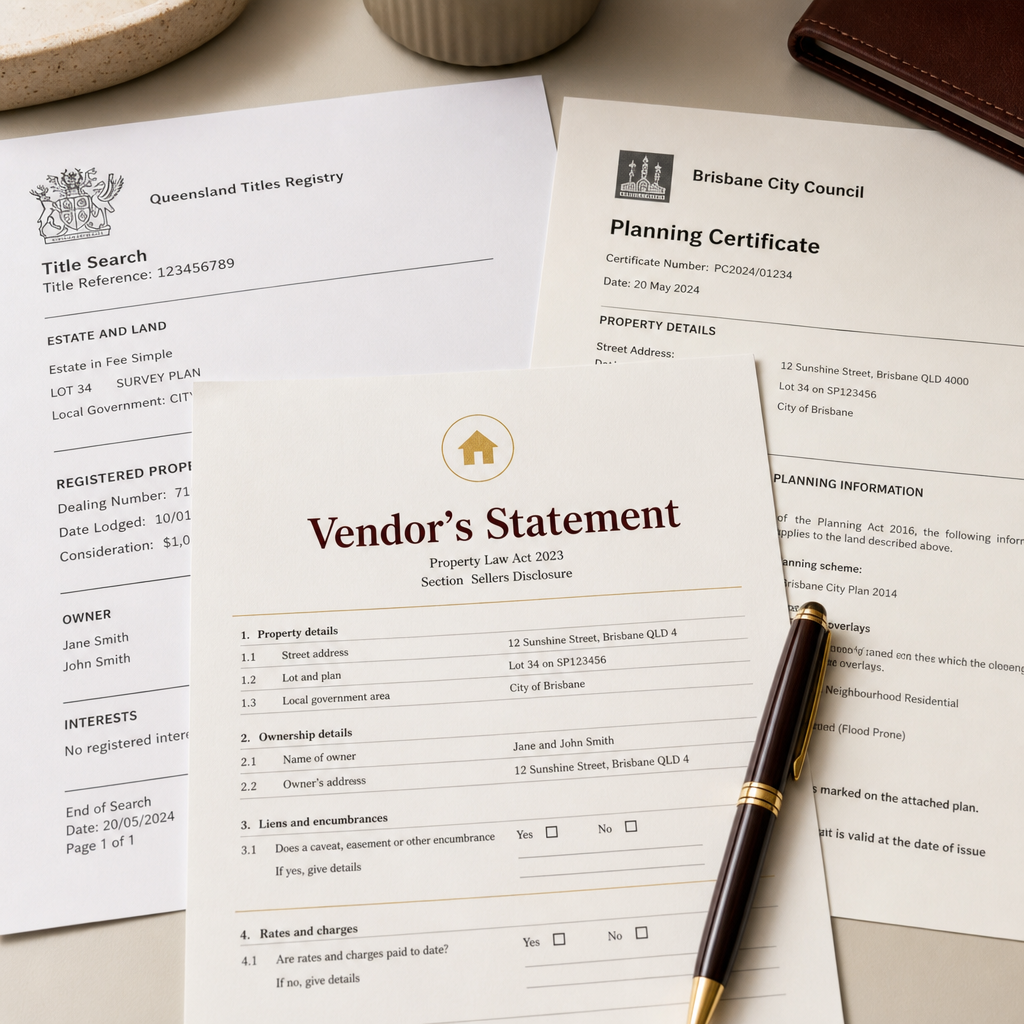
Section 32 takes its name from Section 32 of the Sale of Land Act 1962 (VIC). It is a document that a property vendor in Victoria must give to a prospective buyer before that buyer signs a contract of sale. The law is clear: a buyer cannot be bound by a contract unless they have first received and signed the Section 32.
The purpose of the document is to give buyers the information they need to make an informed decision before they are legally committed. It is a disclosure obligation, not a sales document. It tells the buyer what they are actually buying: the encumbrances on the title, the planning constraints on the land, the outgoings they will inherit, the state of services connected to the property, and any building work that has been carried out.
From a seller's perspective, it is your legal obligation to disclose. You cannot selectively include only the information that flatters your property. If there is a covenant on the title that restricts what can be built, that must be disclosed. If there is a caveat lodged by a creditor, that must be disclosed. If you carried out renovations as an owner-builder, there are specific warranty obligations you must address.
The document is not optional and it is not interchangeable with the contract of sale. The contract sets out the terms of the transaction. The Section 32 sets out the facts about the property. Both are required.
The Legal Foundation
Section 32 of the Sale of Land Act 1962 (VIC) is the primary legislative basis. The Act has been amended multiple times over the decades, and the most significant recent changes have tightened disclosure requirements around planning overlays, vendor terms contracts, and domestic building work. Consumer Affairs Victoria administers the legislation and publishes guidance on what the statement must contain.
It is worth understanding that the Section 32 obligation sits with the vendor, not the agent. Your real estate agent has an important role in coordinating the process and making sure the document is ready before the property is marketed, but the legal responsibility for the accuracy of the statement rests with you as the seller.
What Happens If You Get It Wrong
If a Section 32 is defective, a buyer may be entitled to rescind (cancel) the contract. Under the Sale of Land Act, a buyer can rescind if the statement is false, misleading, or incomplete in a material way. Importantly, the right to rescind can survive settlement in some circumstances, which means a buyer could theoretically unwind a transaction after they have already taken possession. That is an extreme outcome, but it illustrates how seriously the law treats this obligation.
Beyond rescission, sellers can face claims for compensation if a buyer suffers loss because of a misleading statement. The ACCC and state consumer protection regulators take misleading conduct in property transactions seriously.
What Must Be Included in a Section 32
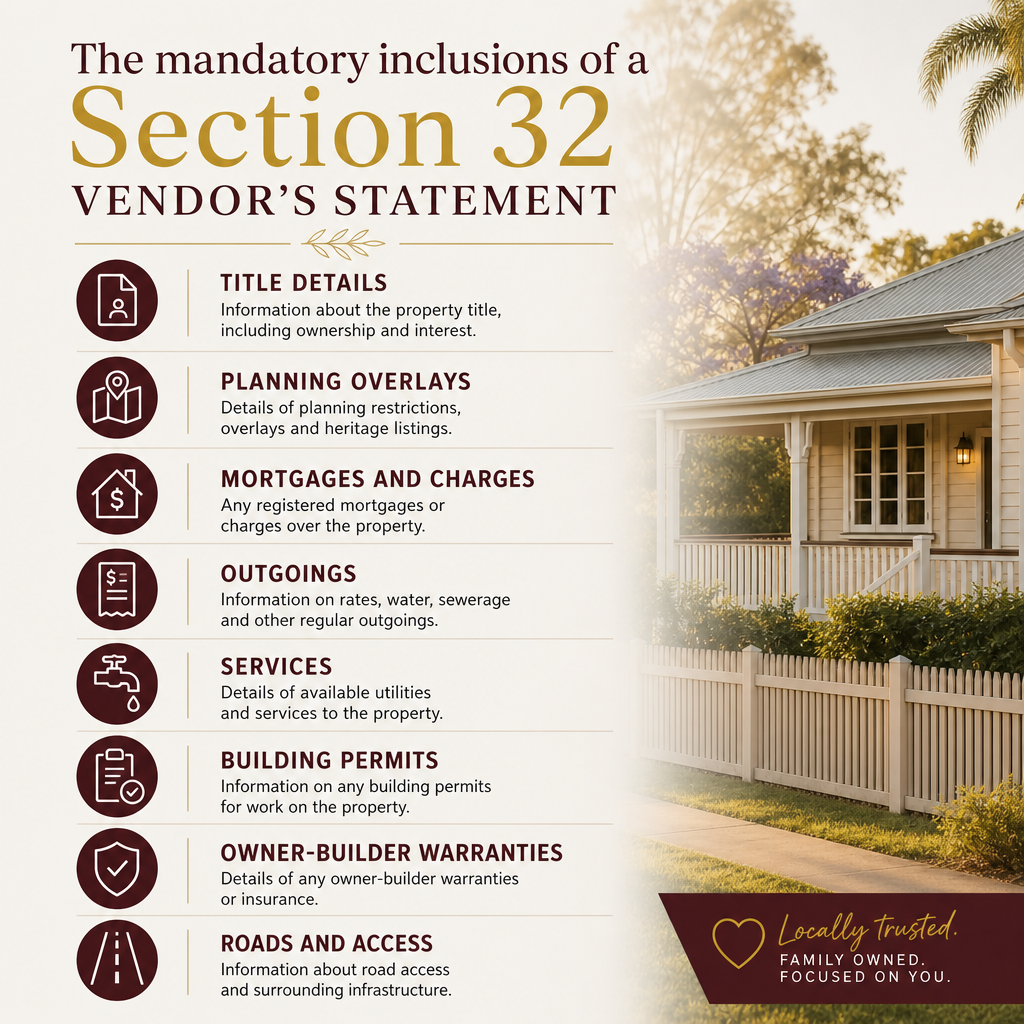
The Sale of Land Act 1962 (VIC) sets out the specific information that must be included. This is not a grab-bag of nice-to-haves. Each item is a mandatory disclosure requirement. Here is a thorough breakdown.
Title Details
The statement must include a copy of the title search, showing the registered proprietor, the volume and folio number, the legal description of the land, and any registered encumbrances. Encumbrances include mortgages, easements, covenants, and caveats.
Easements are particularly important. An easement might give a neighbour the right to pass over part of your land, or give a utility company the right to access a drain or cable running under your property. Buyers have the right to know about these before they sign. A title search from Land Use Victoria will show all registered encumbrances.
Planning and Zoning Information
The statement must disclose the zoning of the land under the relevant planning scheme, and any overlays that apply. Victoria's planning system uses a layered approach: a property might be in a General Residential Zone but also subject to a Bushfire Management Overlay, a Heritage Overlay, or a Flood Overlay. Each overlay imposes additional requirements and restrictions on what can be done with the land.
This information comes from a planning certificate issued by the local council. Sellers cannot rely on their own knowledge of zoning. The certificate must be current and attached to the statement.
Mortgages and Charges
All mortgages and charges registered over the property must be disclosed. This is straightforward in most residential sales: the seller has a mortgage, the buyer knows there is a mortgage, and at settlement the mortgage is discharged from the sale proceeds. But if there are other charges, such as a judgment debt registered against the title, a charge from the Australian Taxation Office, or a private caveat, these must all be disclosed.
Outgoings
The statement must disclose the outgoings associated with the property. For a standard residential property this includes council rates, water rates, and any owners corporation (strata) levies. For properties subject to an owners corporation, the statement must include a copy of the owners corporation certificate, which sets out the levies, any special levies, the financial position of the owners corporation, and any current disputes or litigation.
This is one of the most commonly underestimated sections. Owners corporation certificates take time to obtain, sometimes up to two weeks, and they cost money. If you are selling an apartment or a property in a shared complex, factor this into your preparation timeline.
Services
The statement must confirm what services are connected to the property. This means mains water, sewerage, gas, and electricity. If the property is not connected to mains sewerage and instead relies on a septic system, that must be disclosed. If there is no mains gas connection, that must be stated.
Building Permits
Any building permit issued for work on the property in the last seven years must be disclosed, along with the date the permit was issued and whether an occupancy permit or certificate of final inspection was issued at the conclusion of the work. This is where many sellers get caught out.
If you had a deck built, a garage converted, a bathroom added, or a swimming pool installed, there is likely a building permit that must be disclosed. If the work was done without a permit, that is a significant issue that your conveyancer needs to address. It does not necessarily kill the sale, but it must be handled correctly.
Owner-Builder Warranties
If the property has had domestic building work carried out by the owner as an owner-builder in the last ten years, and the value of that work exceeded the prescribed threshold (currently $16,000 in Victoria), the seller must obtain a defects inspection report from a registered building inspector and provide that report and the owner-builder certificate to the buyer. This is a non-negotiable requirement and it catches a surprising number of sellers off guard.
Roads and Access
The statement must disclose information about the roads that provide access to the property: whether they are constructed, maintained, and dedicated as public roads. For rural properties or properties accessed via private roads, this can be a more complex disclosure.
Vendor's Statement Declaration
The vendor must sign a declaration confirming that the information in the statement is true and correct to the best of their knowledge. This declaration is where the legal weight sits. Signing a false or misleading declaration is not just a civil issue; it can give rise to criminal liability under the Australian Consumer Law.
Who Prepares the Section 32 and What Does It Cost
Only a licensed legal practitioner (solicitor or barrister) or a licensed conveyancer can prepare a Section 32 vendor's statement in Victoria. Your real estate agent cannot prepare it, and you cannot prepare it yourself. This is not a technicality; it is a legal requirement under the Legal Profession Uniform Law and the Conveyancers Act 2006 (VIC).
In practice, most sellers engage either a property solicitor or a licensed conveyancer. Both are qualified to do the work. The choice often comes down to the complexity of the property and your relationship with a particular firm. For straightforward residential sales, a conveyancer is typically sufficient and often more cost-effective. For more complex transactions, such as properties with unusual encumbrances, off-the-plan sales, or subdivision components, a solicitor with specific property law expertise is worth the additional cost.
Typical Costs
Preparation of a Section 32 as a standalone service typically costs between $300 and $600 AUD for a standard residential property. If the Section 32 is bundled with full conveyancing services for the sale, expect total conveyancing fees of $1,200 to $2,500 AUD depending on the complexity of the transaction and the firm you engage. Owners corporation certificates add to this cost, typically $100 to $250 per owners corporation, and in large mixed-use developments there can be multiple owners corporations applicable to a single lot.
Additional costs to factor in include the title search fee, the planning certificate fee (payable to the council), and any building permit searches from the Building Information Request service. These disbursements typically add $150 to $400 to the overall cost.
Choosing the Right Professional
When selecting a conveyancer or solicitor, ask them specifically how they handle Section 32 preparation, what their turnaround time is, and what happens if they identify a problem with your title or building permits. A good conveyancer will not just populate a template. They will review the title and flag issues before you sign off on the statement, giving you time to address any problems before the property is on the market.
If you are unsure where to start, your real estate agent should be able to refer you to conveyancers they have worked with and trust. At George & Sons, we work closely with our sellers from the very beginning of the process, which means we can connect you with the right professionals early. You can learn more about how we approach the selling process on our real estate services page.
Common Mistakes Sellers Make With the Section 32
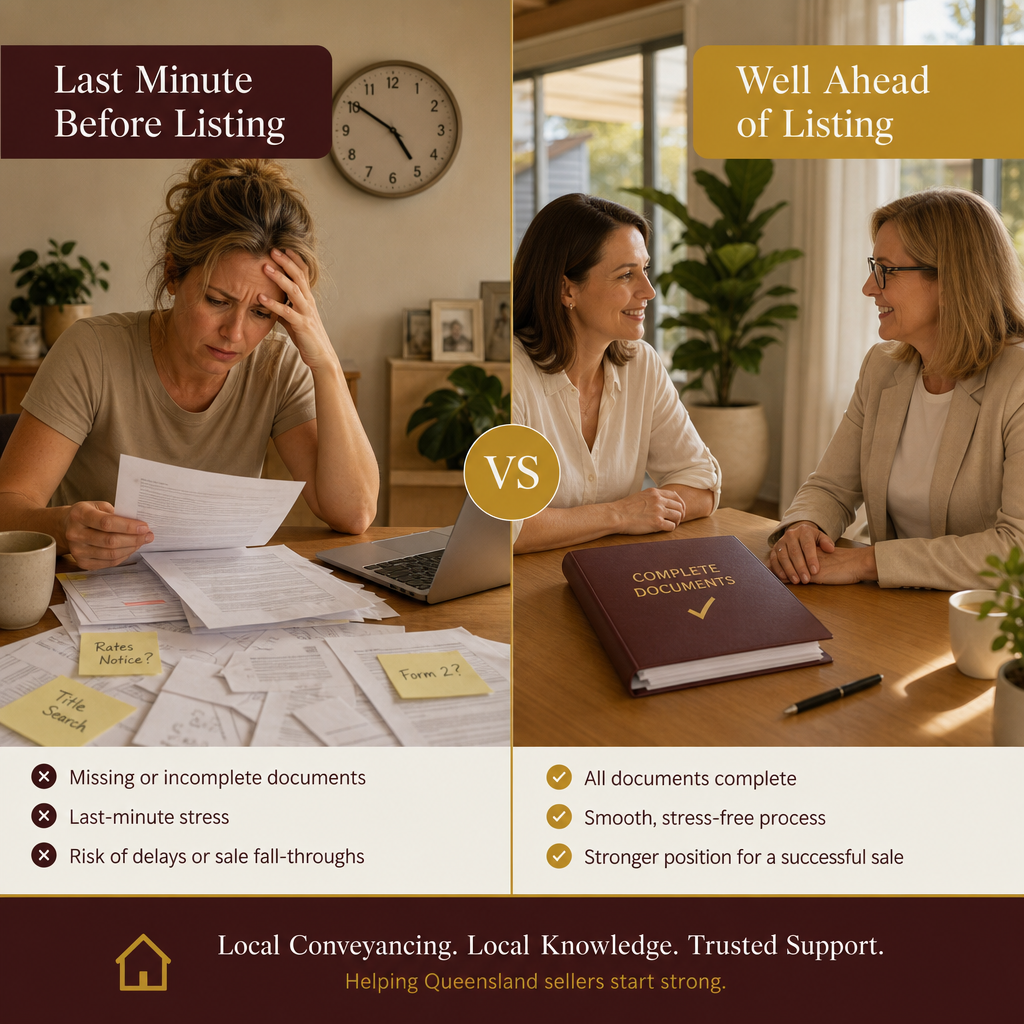
After working with sellers across southeast Queensland and beyond, I have seen the same mistakes come up again and again. Here are the most common ones, and how to avoid them.
Leaving It Too Late
This is the number one mistake. Sellers who engage a conveyancer a week before they want to list are setting themselves up for problems. Gathering all the documents required for a Section 32, including the title search, the planning certificate, the owners corporation certificate if applicable, and the building permit history, takes time. Rushing this process increases the risk of something being missed.
Engage your conveyancer at least four to six weeks before your expected listing date. In a hot market where you want to move quickly, that timeline discipline is what separates a smooth sale from a stressful one.
Forgetting Building Permits
Sellers frequently forget about building permits for work done years ago, especially small jobs. That deck you had built five years ago, the carport, the pergola, the pool fence upgrade: all of these may have associated permits that need to be disclosed. A building permit search through the relevant council or the Building Information Request system will identify what is on record.
The more dangerous situation is work that was done without a permit when a permit was required. If you know about unpermitted building work on your property, do not try to conceal it. Tell your conveyancer immediately. There are legitimate pathways to address the issue, including obtaining a retrospective inspection or including appropriate special conditions in the contract, but concealment is not one of them.
Outdated or Incorrect Information
A Section 32 is a snapshot of the property's legal position at the time it is prepared. If circumstances change after it is prepared but before the buyer signs, the statement may need to be updated. For example, if a caveat is lodged on the title between the time the statement is prepared and the time the buyer signs, the statement needs to reflect that.
Sellers sometimes assume that once the document is prepared, the job is done. It is not. Stay in contact with your conveyancer throughout the marketing period so that any changes can be captured and the statement updated if necessary.
Getting the Owners Corporation Section Wrong
For apartments and townhouses in shared complexes, the owners corporation section is frequently incomplete. The most common error is using an outdated owners corporation certificate. These certificates have a limited shelf life. A certificate that was obtained three months ago may no longer accurately reflect the current levies or financial position of the owners corporation.
For sellers of units and apartments, I always recommend engaging the conveyancer early enough to allow time to obtain a current certificate, and to budget for the certificate cost in your preparation expenses.
Signing a Statement You Have Not Read
You are the one signing the vendor's declaration. You are affirming that the information is true and correct to the best of your knowledge. If your conveyancer sends you the completed statement to sign and you sign it without reading it, you are taking on legal liability for the content without verifying it. Take the time to read it. If something looks wrong or you are not sure about something, ask your conveyancer to explain it before you sign.
Case Studies: How Proper Preparation Protects Sellers
Case Study 1: The Apartment Complex Developer
Back in early 2021, I was brought in to help sell apartments in a Beenleigh complex. The developer was sceptical about what we could offer. He had dealt with other agents and felt the process was always reactive rather than proactive.
What made the difference was preparation. Before any apartment was listed, I made sure I understood every aspect of the complex: the body corporate structure, the levies, the building permits for each lot, and the disclosure requirements for new builds. The owners corporation certificates were obtained fresh for each sale. Building permits and occupancy certificates were in order.
The result was that across twelve apartment sales over five years, we never had a settlement delayed by a Section 32 issue. Buyers had everything they needed in the disclosure documentation before they signed. Their solicitors and conveyancers could review the material without coming back with queries that stalled the process. When documentation is complete and accurate, transactions move faster.
Case Study 2: The Heritage-Overlaid Home
A seller came to us with a home in an inner suburb that had a Heritage Overlay over the property. They were unaware of the overlay's practical implications: restrictions on what external changes could be made to the property, and a requirement to apply to council for certain works that would be permit-exempt on other properties.
The planning certificate obtained for the Section 32 flagged the overlay clearly. Rather than treating this as an obstacle, we worked with the seller's conveyancer to prepare accurate disclosure and then made sure our marketing materials accurately described the property's heritage character as an asset, not a liability. Heritage homes attract buyers who specifically want that character, and pricing and marketing the property accordingly resulted in a strong outcome. The buyers' solicitor reviewed the Section 32, noted the heritage overlay was fully disclosed, and the contract proceeded without issue.
The alternative, had the overlay not been disclosed or had the seller tried to downplay it, is that the buyer could have argued misleading conduct and sought to rescind or renegotiate after signing.
How the Section 32 Fits Into the Selling Timeline
Understanding where the Section 32 sits in the overall selling process helps you plan properly. If you want a broader picture of the end-to-end sale process, our guide to the property settlement process in Australia is a good companion to this article.
The Recommended Timeline
Here is how a well-managed Section 32 preparation fits into a typical selling campaign:
Six to eight weeks before listing: Engage your conveyancer. Brief them on the property, including any building work carried out in the last ten years, any known encumbrances, and whether the property is subject to an owners corporation. Instruct them to begin gathering documents.
Four to six weeks before listing: Title search, planning certificate, and owners corporation certificate (if applicable) are obtained. Building permit history is checked. Any issues identified at this stage, such as unregistered easements, outstanding permits, or disputes with the owners corporation, give you maximum time to resolve them.
Two to four weeks before listing: Draft Section 32 is prepared by your conveyancer. You review and sign the vendor's declaration. The completed statement is provided to your real estate agent.
At listing: The Section 32 is available to prospective buyers. In Victoria, buyers must receive and sign the statement before they sign the contract of sale.
Offer and acceptance: When a buyer makes an offer and it is accepted, the Section 32 (already signed by the buyer) forms part of the contract documentation.
Cooling-off period: In Victoria, a buyer has a three-business-day cooling-off period after signing the contract, unless they waive this right. During this period, the buyer can rescind and forfeit 0.2% of the purchase price.
Settlement: Typically 30 to 90 days after contract signing, depending on what is agreed. The Section 32 does not expire at this point, but any material changes to the property's legal position between signing and settlement should be discussed with your conveyancer.
State-by-State Differences in Vendor Disclosure
While this guide focuses primarily on Victoria, where the Section 32 is the most formalised and prescribed vendor disclosure document in Australia, it is worth understanding how other states approach the same obligation.
New South Wales
NSW does not have a standalone document called a Section 32. Instead, vendor disclosure in NSW is achieved through the contract of sale itself, which must have specific documents attached before it is made available to buyers. These include:
- A copy of the title search
- A sewer diagram
- A zoning certificate (Section 10.7 certificate, formerly Section 149 certificate) from the local council
- A copy of any relevant plan of subdivision or strata plan
NSW law requires the contract to be prepared before the property is advertised for sale, which means the vendor's solicitor must have the contract and all attachments ready at the time of listing. This is a stricter requirement than many sellers expect.
If the property is sold by auction, the contract (with attachments) must be available for inspection at least 24 hours before the auction.
The cooling-off period in NSW is five business days, and buyers who exercise the cooling-off right forfeit 0.25% of the purchase price.
Queensland
QLD takes a different approach again. The standard REIQ contract of sale is used for most residential transactions, and it contains a range of built-in disclosure mechanisms. Sellers in QLD are required to disclose certain matters, including whether the property is affected by an Encumbrance Notice, body corporate information for lots within community title schemes, and pool compliance certificates.
QLD does not require a separate vendor's statement equivalent to Victoria's Section 32. However, sellers still have disclosure obligations under the Property Law Act 1974 (QLD) and the Body Corporate and Community Management Act 1997 (QLD) for community title properties.
For community title properties (apartments, townhouses in managed complexes), the seller must provide a body corporate information sheet and, if requested by the buyer, a full disclosure statement within five days. The seller's failure to provide required body corporate information can give the buyer a right to terminate the contract.
QLD's cooling-off period is five business days, with a 0.25% penalty for buyers who exercise the right.
The Practical Takeaway
If you are selling in Victoria, the Section 32 is your mandatory disclosure vehicle. If you are selling in NSW or QLD, the obligations work differently but the underlying principle is the same: you must give buyers the information they need to make an informed decision before they are legally committed. The consequences of non-disclosure are material in all three states.
Before you list in any state, speak to a local conveyancer or property solicitor who knows the specific requirements in your jurisdiction. Do not assume the rules are the same across state borders.
How Your Real Estate Agent Helps You Navigate the Section 32 Process
Your real estate agent cannot prepare the Section 32 for you, but a good agent does a great deal to make the process smoother. Here is what that looks like in practice.
Coordinating the Timeline
An experienced agent knows how long it takes to get a property listed and will factor Section 32 preparation into the campaign timeline from day one. If you are working with an agent who has not mentioned the Section 32 in your first meeting, that is a gap worth addressing. The selling process does not begin when the photographs are taken. It begins weeks earlier with legal and marketing preparation.
When choosing a real estate agent to sell your home, asking what their process is for Section 32 preparation is a legitimate and useful question. An agent who can give you a clear, sequenced answer is an agent who has done this before and understands the process.
Identifying Potential Issues Early
An agent who has sold properties in your suburb and property type will often be aware of common disclosure issues for that type of property. Apartments in a particular complex may have a history of body corporate disputes. Heritage overlays are common in certain inner-city suburbs. Rural properties may have complex road access issues. A knowledgeable agent can flag these possibilities before your conveyancer discovers them, giving you a head start on resolution.
Making the Document Accessible to Buyers
Once the Section 32 is prepared and signed, your agent is responsible for making it available to prospective buyers. In practice, this means attaching the document to the property listing on the major portals or providing it via a secure online link to interested parties. In today's market, buyers expect to be able to download and share the Section 32 with their own solicitor or conveyancer quickly and easily.
Supporting Buyers' Questions Without Providing Legal Advice
Buyers will sometimes ask your agent questions about the Section 32. A good agent can explain what the document is and what it covers without crossing into legal advice. If a buyer has a legal question about an encumbrance or a planning overlay, the right answer is always to direct them to their own solicitor or conveyancer. This protects the buyer, protects the seller, and protects the agent.
Getting the Property Ready
Before you even get to the Section 32, making sure your property is presented at its best for the market is essential. Our guide on how to get your property ready to sell covers the presentation and preparation steps that run parallel to your legal preparation.
A Note on Digital Section 32 Documents
With the widespread adoption of electronic conveyancing and digital document management in Australia, it is now common for Section 32 documents to be prepared, signed, and distributed digitally. Platforms such as PEXA (Property Exchange Australia) have transformed the settlement process, and digital signatures are now legally recognised for most property transaction documents in Victoria.
You can sign your Section 32 electronically using a compliant e-signature platform. The document can be distributed to buyers via a secure link. Buyers can sign their acknowledgement electronically. This does not change the legal requirements around content: the same disclosures are required whether the document is paper or digital.
One practical note: even when using digital workflows, make sure there is a clear record of when the buyer received the Section 32 and when they signed it. The Section 32 must be received and signed by the buyer before they sign the contract. If there is any ambiguity about the sequence of events, you have a potential legal problem. A good conveyancer using a proper digital workflow will have this sequencing built into the process.
What Happens if Circumstances Change After the Section 32 Is Signed
This is a question that does not get enough attention. The Section 32 is prepared at a point in time, but the marketing campaign may run for several weeks or months before a buyer signs. What happens if something changes?
If there is a material change to the property's legal position after the Section 32 is prepared but before a buyer signs, the statement may need to be updated. Examples of material changes include a new caveat being lodged on the title, a council order being issued in relation to the property, or a change in the owners corporation's financial position.
If the Section 32 is no longer accurate when a buyer signs it, and the buyer later discovers the inaccuracy, the buyer may have grounds to claim the statement was defective. The safest approach is to notify your conveyancer of any changes as soon as they occur and to have the statement updated if necessary.
After a buyer has signed the contract, the Section 32 is effectively locked in. Any post-contract changes to the property's legal position would need to be dealt with through the contract itself, typically via a special condition or a deed of variation, rather than by amending the Section 32.
References
-
Consumer Affairs Victoria, 'Conveyancing and contracts for sellers': The official Victorian Government guidance on vendor disclosure obligations, the content requirements for a Section 32 vendor's statement, and the legal framework under the Sale of Land Act 1962 (VIC). Published by Consumer Affairs Victoria, updated regularly to reflect legislative changes.
-
Sale of Land Act 1962 (VIC): The primary Victorian legislation governing the sale of land, including Section 32 and the vendor disclosure obligations. Available through the Australasian Legal Information Institute (AustLII) and the Victorian Legislation website.
-
NSW Fair Trading, 'Selling a property': The New South Wales Government's official guidance on vendor obligations in property sales, including contract preparation requirements, the documents that must be attached, and cooling-off rights under the Conveyancing Act 1919 (NSW).
-
Queensland Government, 'Selling a home': The Queensland state government's official guidance on vendor disclosure obligations, body corporate requirements, and the use of REIQ standard contracts under the Property Law Act 1974 (QLD) and the Body Corporate and Community Management Act 1997 (QLD).
-
PEXA Group, 'Annual Property and e-Conveyancing Insights Report 2026': Data on the adoption of digital conveyancing in Australia, including the proportion of property settlements conducted through the PEXA electronic conveyancing platform across VIC, NSW, and QLD. Published by PEXA Group Limited.
-
Australian Bureau of Statistics (ABS), 'Residential Property Price Indexes: Eight Capital Cities': Contextual data on property market activity across Australian capital cities, providing background on transaction volumes and the scale of vendor disclosure obligations in the current market.
Ready to sell your property and want to make sure your Section 32 is handled correctly from the start? Get in touch with the team at George & Sons for a free consultation. We work with sellers across southeast Queensland and beyond, and we make sure the legal preparation is in order before your property hits the market.
Get tailored guidance
Send us your question and we will reply within one business day.
Send us the article topic, suburb, or property goal you want help with and we will reply within one business day.
Send my questionFAQ
How much does a Section 32 vendor's statement cost in Victoria?
Preparing a Section 32 as a standalone service typically costs between $300 and $600 AUD. If you bundle it with full conveyancing services for the sale, total fees typically range from $1,200 to $2,500 AUD depending on the complexity of the property and the firm you use. Allow an additional $150 to $400 for disbursements including the title search, planning certificate, and building permit searches. Owners corporation certificates, if required, typically add $100 to $250 per owners corporation.
How far in advance should I start preparing the Section 32?
Engage your conveyancer at least four to six weeks before your expected listing date. This gives sufficient time to gather all required documents, including the title search, planning certificate, and owners corporation certificate if applicable. If you suspect complications such as unpermitted building work or an unusual encumbrance on the title, allow eight weeks.
What are the penalties for errors or omissions in a Section 32?
If a Section 32 is false, misleading, or incomplete in a material way, a buyer may be entitled to rescind the contract under the Sale of Land Act 1962 (VIC). The right to rescind can survive even after settlement in some circumstances. Sellers may also face compensation claims if a buyer suffers financial loss because of a misleading statement, and deliberate misrepresentation may attract scrutiny under the Australian Consumer Law.
Can a Section 32 be provided as a digital document?
Yes. Electronic Section 32 documents are legally recognised in Victoria, provided the e-signature platform used is compliant with the Electronic Transactions Act 2000 (VIC). The key requirement remains the same: the buyer must receive and sign the Section 32 before they sign the contract of sale. Your conveyancer's digital workflow should document this sequencing clearly.
Can a Section 32 be updated after a buyer has signed it?
No. Once a buyer has signed the Section 32 and then signed the contract, the Section 32 is fixed. Any material changes to the property's legal position that occur after the contract is signed need to be addressed through the contract itself, typically via a special condition or a deed of variation negotiated between the parties.
Does a Section 32 affect the buyer's cooling-off rights in Victoria?
Yes. In Victoria, the three-business-day cooling-off period for a buyer begins on the day they sign the contract of sale. The buyer must have first received and signed the Section 32 before signing the contract. If the Section 32 is found to be defective, a buyer's right to rescind may extend beyond the standard cooling-off period.
Do NSW and QLD sellers need a Section 32?
No. The Section 32 vendor's statement is specific to Victoria under the Sale of Land Act 1962 (VIC). NSW sellers must have a contract of sale prepared before advertising, with specific documents attached. QLD sellers have disclosure obligations under the Property Law Act 1974 (QLD) and, for community title properties, under the Body Corporate and Community Management Act 1997 (QLD). Requirements differ in format and timing across states.
What happens if a property is sold at auction in Victoria? Does the Section 32 still apply?
Yes. For properties sold at auction in Victoria, the Section 32 must be available for inspection by prospective buyers at least three days before the auction. There is no cooling-off period for properties purchased at auction in Victoria, making the Section 32 the buyer's primary opportunity to understand the legal position of the property before they are committed.
Margy George
Property and finance guidance from the George & Sons team.
Keep reading
property settlement process australia
Understanding the Property Settlement Process in Australia: What Sellers Need to Know
25 min read
property management fees Australia
Property Management Fees in Australia: A Comprehensive Guide for Landlords
19 min read
real estate market trends Australia
35 Australian Real Estate Market Statistics for 2026
20 min read
Ready for clarity?
Get a calm, practical plan for your next property move.
Buying, selling, finance, or renting - tell us what you are working on and we will come back with the most useful next step.
Tell us what you need help with.
Send a quick enquiry and the team will come back with a clear next step.
Request a callback