negative gearing Australia
Negative Gearing in Australia Explained: How Property Investors Reduce Tax in 2026
Most people who ask me about negative gearing have heard the term a hundred times. They know it has something to do with property and tax. But when I ask them to explain exactly how a rental loss reduces what they owe the ATO, the room goes quiet. That gap between hearing a concept and understanding it well enough to act on it is exactly where poor investment decisions are made.
Negative gearing is one of the most widely used tax strategies in Australia, and it is also one of the most misunderstood. It is not a loophole. It is not a gift to wealthy investors. It is a straightforward application of the principle that deductible business expenses can offset taxable income. When your investment property costs more to hold than it earns in rent, that net loss reduces your assessable income at your marginal tax rate. Done right, the short-term cash flow hit is offset by a tax saving today and capital growth over time.
In this guide, I will walk you through exactly how negative gearing works in Australia in 2026, including the ATO rules, a worked dollar example, how it interacts with capital gains tax, the real risks involved, and two case studies drawn from properties I have worked with directly. Whether you are weighing up your first investment property or reviewing an existing portfolio, this is the foundation you need.
Key Takeaways
- Negative gearing occurs when your rental property expenses (including interest, depreciation, and maintenance) exceed your rental income, creating a net loss you can offset against other taxable income.
- The tax benefit is proportional to your marginal tax rate. At 47% (including the Medicare levy), a $10,000 loss saves $4,700 in tax. At 34.5%, the same loss saves $3,450.
- Negative gearing relies on capital growth to be profitable over the long term. The tax saving alone does not make a poor-performing asset a good investment.
- The ATO allows a wide range of deductible expenses, including loan interest, depreciation, rates, property management fees, insurance, and repairs.
- When you sell, capital gains tax applies to the profit. If you have held the property for more than 12 months, you are eligible for the 50% CGT discount, which significantly affects your net outcome.
- Interest rate movements directly affect how deeply negatively geared a property is. The current RBA cash rate environment in 2026 means investors need to stress-test their numbers carefully before committing.
Summary Table: Negative, Neutral, and Positive Gearing Compared
| Feature | Negative Gearing | Neutral Gearing | Positive Gearing |
|---|---|---|---|
| Rental income vs expenses | Income < Expenses | Income = Expenses | Income > Expenses |
| Annual cash flow | Negative (out of pocket) | Breakeven | Positive (cash surplus) |
| Tax effect now | Reduces taxable income | No immediate effect | Increases taxable income |
| Ideal market condition | High capital growth areas | Stable, low-yield markets | High-yield, moderate-growth markets |
| Typical Australian example | Sydney or Melbourne inner suburbs | Regional centres, established units | Queensland regional towns, commercial property |
| Key risk | Relies on capital growth; cash flow strain | Misses tax upside | Tax drag on rental income |
| ATO treatment | Net loss deductible against other income | No loss to claim | Rental surplus added to assessable income |
What Is Negative Gearing?
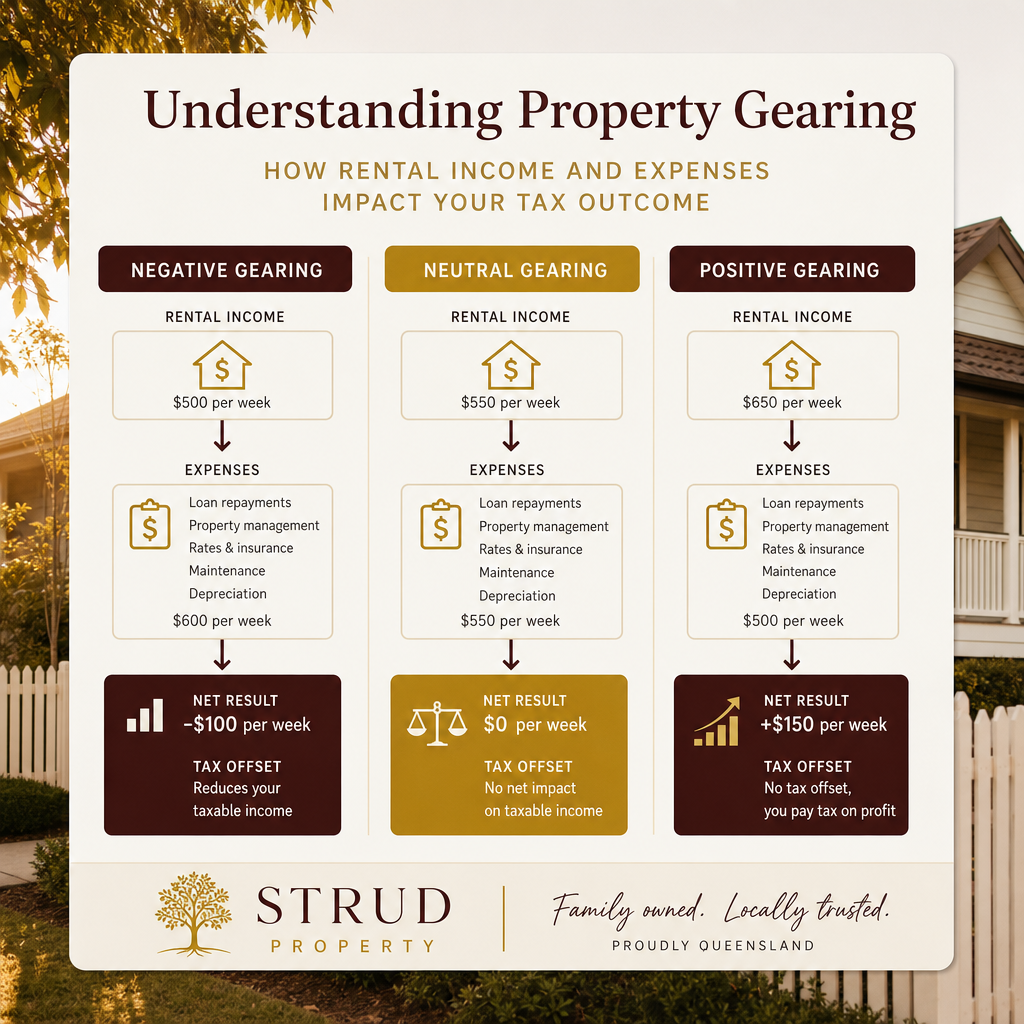
Negative gearing simply means the costs of owning an investment property are greater than the income it produces. The word "gearing" refers to borrowing money to invest. When you gear into an asset, you use debt to fund the purchase, which means interest becomes your largest holding cost.
If your investment property earns $28,000 in rent over a year but costs you $38,000 to hold (interest, rates, insurance, property management, maintenance, and depreciation), you have a $10,000 net rental loss. Under Australian tax law, that $10,000 loss is deductible against your other income, most commonly your salary or wages. If you are on a marginal tax rate of 37%, that loss saves you $3,700 in tax. If you are on 45% plus the 2% Medicare levy, the saving is $4,700.
The ATO's position on this is clear and has been consistent for decades. Section 8-1 of the Income Tax Assessment Act 1997 allows deductions for losses or outgoings incurred in gaining or producing assessable income, provided they are not capital in nature. Rental property expenses qualify. The ATO publishes detailed guidance in its Rental properties guide (updated annually), which sets out exactly what can and cannot be claimed.
It is worth being precise about what counts as an expense. The ATO distinguishes between immediately deductible expenses (loan interest, council rates, property management fees, insurance, repairs to pre-existing damage) and capital works deductions claimed over time (renovations, structural improvements). There is also a separate category for depreciation on plant and equipment, such as appliances, carpets, and hot water systems, which is governed by the effective life schedule the ATO publishes each year.
One important rule change that investors often overlook: since the 2017-18 Federal Budget, travel expenses to inspect investment properties are no longer deductible for individual investors (though they remain deductible for genuine property businesses). Depreciation on second-hand plant and equipment purchased as part of a property after 9 May 2017 is also restricted. If you are buying an established investment property, this materially affects how much depreciation you can claim, and it is something a quantity surveyor can help you assess before you buy.
How Negative Gearing Works in Practice: A Worked Dollar Example

Let me put real numbers to this so the concept is concrete rather than abstract.
Assume you buy a two-bedroom apartment in a Brisbane suburb for $650,000. You put in a 20% deposit ($130,000) and borrow $520,000 at an interest rate of 6.2% per annum (a reasonable variable rate benchmark in 2026 given the RBA's cash rate environment). Your annual interest bill is $32,240.
Now let us build the full picture.
Annual Rental Income Weekly rent: $550 Annual rental income: $28,600
Annual Deductible Expenses
- Loan interest: $32,240
- Property management fees (8% of rent): $2,288
- Council rates: $1,800
- Water rates: $900
- Landlord insurance: $1,400
- Repairs and maintenance: $1,200
- Depreciation (building allowance at 2.5% on $250,000 construction cost): $6,250
- Depreciation (plant and equipment, new build): $2,100
- Accounting/tax agent fees: $500
Total Deductible Expenses: $48,678
Net Rental Loss: $28,600 minus $48,678 equals negative $20,078
Now apply that loss against a salary of $120,000. The taxable income drops from $120,000 to $99,922. At current ATO tax rates, the difference in tax payable is approximately $7,429 (at an effective marginal rate of roughly 37%). That means the government is effectively covering $7,429 of your $20,078 shortfall.
Your actual out-of-pocket cash position is the $20,078 loss minus $2,100 of non-cash depreciation (building allowance is also non-cash) and minus the $7,429 tax refund, giving a real cash cost of around $10,549 for the year, or roughly $203 per week.
The question then is: will the property grow in value by more than $10,549 per year? In a market like Brisbane's inner south, CoreLogic data has consistently shown annualised growth rates that have well exceeded that figure over 10-year horizons. But growth is never guaranteed, and that is exactly the risk I will address shortly.
Negative Gearing vs Positive Gearing vs Neutral Gearing
These three terms sit on a spectrum, and understanding where your property sits matters enormously for both tax planning and cash flow management.
Positive gearing is the opposite of negative gearing. Your rental income exceeds all holding costs, giving you a surplus each year. The surplus is assessable income, so you pay tax on it. Positive gearing is more common in higher-yield markets, regional areas, or when you have paid down enough of the loan that interest costs are low. Investors often move from negatively geared to positively geared over time as rents rise and the loan balance falls.
Neutral gearing is where income equals expenses. There is no taxable loss and no taxable surplus from the property itself. In practice, a property rarely stays perfectly neutral, but some investors deliberately structure their loan repayments and rent levels to sit close to breakeven, particularly if they are already in a high tax bracket and prefer the capital growth story over any tax benefit.
Negative gearing is where costs exceed income. As explained above, the net loss flows through to offset other taxable income. This is the most common structure for property investors in high-growth Australian metro markets, where yields are typically lower relative to purchase prices.
The right structure for you depends on your marginal tax rate, your risk tolerance, your cash flow position, and where you are buying. Someone on a $70,000 salary with limited cash reserves is in a very different position to a professional on $200,000 who can comfortably cover a $300 per week shortfall. Our team at George & Sons Finance works through these numbers with clients before any purchase decision is made, because the structure of the investment matters as much as the property itself.
What Expenses Are Deductible on a Negatively Geared Property?
The ATO's rental property guide is thorough, but let me summarise the key deductible categories that most residential investors encounter.
Interest on investment loans is the biggest deduction for most investors. The full interest component of your repayment is deductible. Principal repayments are not. If you have a split loan or use a redraw facility, you need to be careful about how you use redrawn funds, as mixing personal and investment purposes can compromise deductibility.
Property management fees paid to a licensed real estate agent are fully deductible. This includes letting fees, management fees, and lease renewal fees.
Council rates and water charges are deductible to the extent they relate to rental periods rather than periods of personal use.
Landlord insurance and building insurance premiums are fully deductible.
Repairs and maintenance are deductible when they restore an item to its original condition. Improvements, by contrast, must be capitalised and claimed as a capital works deduction at 2.5% per year over 40 years. The distinction matters and is one of the most common areas of ATO scrutiny in rental property audits.
Depreciation falls into two streams. Division 43 (capital works) covers the building structure and fixed improvements, claimable at 2.5% per year if the building was constructed after July 1985. Division 40 covers plant and equipment (ovens, dishwashers, carpets, blinds, air conditioning units), each depreciated over its ATO-determined effective life. A quantity surveyor's depreciation schedule, typically costing $600-$900, can identify tens of thousands of dollars in deductions over the life of the investment.
Borrowing costs (loan establishment fees, mortgage broker fees, title search fees, lenders mortgage insurance if applicable) can be deducted over five years or the loan term, whichever is shorter.
Accounting and tax agent fees for preparing your rental property schedule are deductible in the year they are paid.
Negative Gearing and Capital Gains Tax: The Full Picture
Negative gearing does not exist in isolation from capital gains tax. The two are deeply linked, and any serious investor needs to understand how they interact.
When you sell an investment property, the difference between your cost base and your sale price is a capital gain. The cost base includes the original purchase price, stamp duty, legal fees, and capital improvements made during ownership. It does not include expenses you have already deducted, such as interest payments and repairs.
If you have owned the property for more than 12 months, you are eligible for the 50% CGT discount. This means only half the capital gain is added to your assessable income in the year of sale. For example, if you sell the Brisbane apartment above for $900,000 after buying it for $650,000, your gross capital gain is $250,000. After the 50% discount, $125,000 is added to your taxable income in the year of sale.
This is why many investors accept years of negative cash flow. If you are collecting a $7,000 annual tax saving and the property grows by $30,000-$40,000 per year, the arithmetic of negative gearing makes sense. The tax saving reduces your holding cost while you wait for growth to compound.
For a detailed breakdown of how CGT works when you sell, including the specific rules around the six-year rule, partial exemptions, and how to calculate your cost base, read our Capital Gains Tax guide for property sellers.
The Risks and Realistic Caveats of Negative Gearing
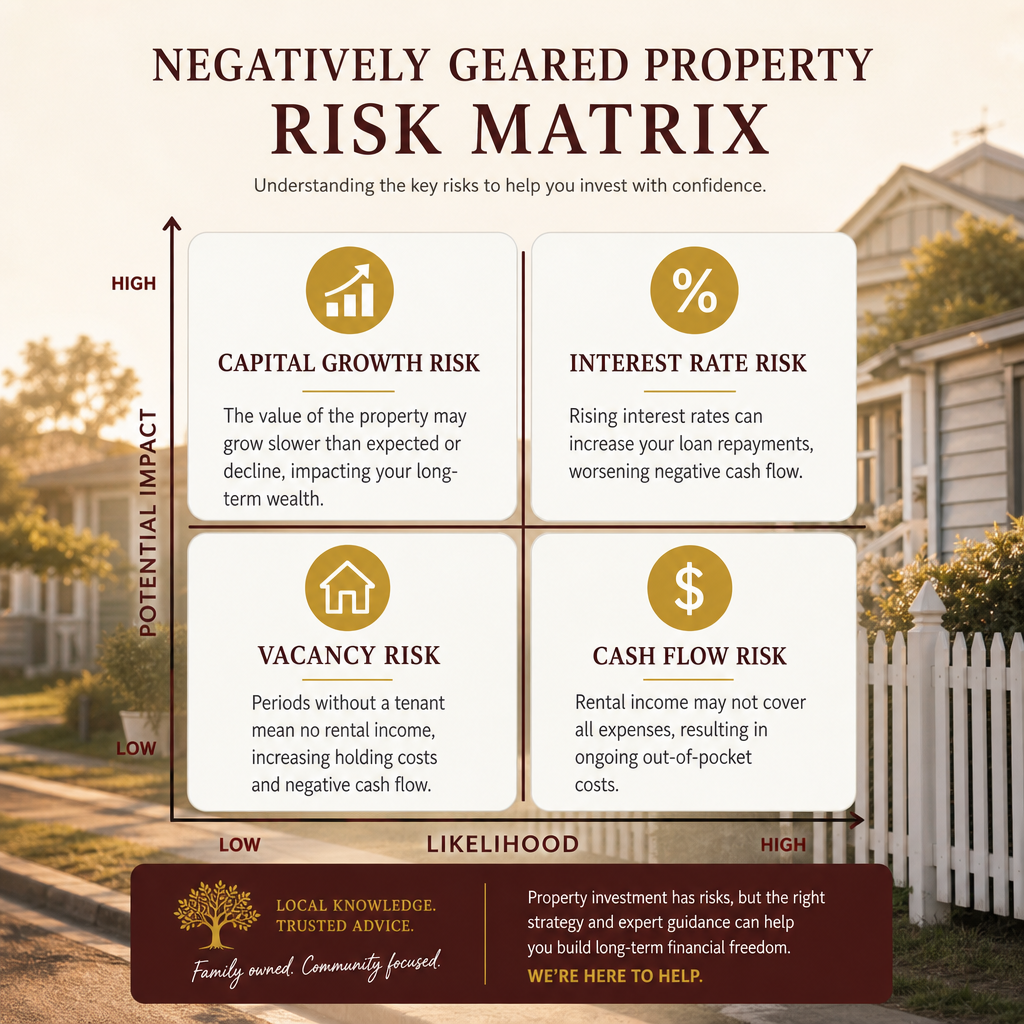
I am not in the business of selling negative gearing as a concept. It is a tool, and like any tool, it can do damage when misapplied. Here are the risks you need to weigh honestly.
Capital growth is not guaranteed. The entire rationale for accepting a negative cash flow rests on the assumption that the property will grow in value. In most of Sydney, Melbourne, Brisbane, and Perth over the past 20 years, that assumption has held reasonably well. But there are suburbs, property types, and market cycles where values have gone sideways or fallen. Buying a property with poor fundamentals and hoping the tax benefit compensates is a losing strategy.
Interest rate sensitivity. The depth of negative gearing is directly proportional to your interest rate. When rates are low, some properties that are currently negatively geared may become closer to neutral. When rates rise, the loss deepens and your out-of-pocket cost increases. Investors who stretched into high-debt positions at the historically low rates of 2021 found this out sharply through the RBA's rate cycle that followed. In 2026, the cash rate has stabilised but remains above the lows of prior years. Stress-testing your numbers at a rate 1.5-2% above your current rate is a basic prudential step.
Cash flow strain. A negatively geared property requires you to cover the shortfall from your own income every single week. If you lose your job, face a major health issue, or have a prolonged vacancy in the property, that shortfall still exists. Most financial advisers recommend keeping a 3-6 month cash buffer to cover holding costs before committing to a negatively geared investment.
Vacancy risk. If the property sits empty, you still pay all the holding costs but receive no rent. Selecting properties in suburbs with strong rental demand and low vacancy rates (CoreLogic and SQM Research both publish suburb-level vacancy data) materially reduces this risk.
Tax law risk. Negative gearing rules have been subject to policy debate in Australia for many years. While the rules remain intact as of 2026, investors should not ignore the possibility that future governments could change the treatment. The current ATO framework has not been amended in any material way for residential investors as of the time of writing, but building a portfolio that only works under current tax rules is a form of concentration risk.
Leveraged losses compound. If a negatively geared property falls in value, you face not only a capital loss but also the accumulated cash flow shortfall you have paid over the holding period. A $650,000 property that drops to $580,000 over three years while costing you $10,000 per year in net losses leaves you $90,000 worse off, before transaction costs. Location selection is everything.
Case Study 1: A Beenleigh Apartment Complex
I was referred in to appraise a newly completed apartment complex in Beenleigh back in January 2021. The developer was frank with me. He said he was not sure I could do anything but to give it a go. I did not take that personally. I made sure I knew every detail about the complex, the body corporate structure, the building specifications, and the surrounding rental market before I had a single conversation with a buyer. I walked every prospective purchaser through the property and took a genuine interest in understanding what they were actually looking for.
That first apartment sold quickly, and so did the second. Five years on, as of 2026, we have sold 12 apartments in that complex and are still going. Several of those buyers were investors who structured the purchase as negatively geared holdings. At the time of purchase, the apartments were generating gross rental yields of around 5.2%, with total holding costs (at then-current interest rates) producing a net loss of roughly $8,000-$12,000 per year depending on the individual loan structure. The buyers who held through have seen values appreciate materially, with comparable units in the complex now transacting at 20-28% above their 2021 purchase prices.
The lesson here is not simply that property goes up. It is that properties in well-located, well-managed complexes with genuine rental demand tend to reward patient investors who understand their holding cost from day one. The tax deductibility of the annual loss made the holding cost manageable. The growth made the overall investment work.
Case Study 2: Inner Brisbane Townhouse, High-Income Professional
A professional client, a specialist working in the Queensland health system, came to us looking to reduce a significant tax liability. She was earning above $180,000 per year, placing her firmly in the 45% marginal tax bracket (plus the 2% Medicare levy, effective 47% on each additional dollar). She purchased a three-bedroom townhouse in a south-side Brisbane suburb for $820,000 in late 2023, with an 80% LVR loan.
Her total deductible expenses in the first full financial year came to $62,400, against rental income of $39,000. The net rental loss was $23,400. At her marginal rate, this produced a tax saving of approximately $10,998. Her real out-of-pocket holding cost, after accounting for non-cash depreciation of $8,200 and the tax saving, was approximately $4,202 for the year, or $81 per week.
For someone on her income, paying $81 per week to hold an $820,000 asset in a suburb with consistently below-2% vacancy rates and strong owner-occupier demand is a rational decision. The key was getting the numbers right before purchase, not rationalising a decision after the fact. Our real estate team worked alongside her finance broker to model three scenarios (flat market, moderate growth, strong growth) before she committed.
Testimonial
"Before I spoke to the team at George and Sons, I had been told by two other agents that the property just needed to sit on the market and the right buyer would come. They helped me understand the numbers on my investment properly, including how my holding costs stacked up against what similar properties were actually renting for in the area. Having that clarity made the decision process far less stressful. I felt like I was making a decision, not just hoping."
Property investor, Beenleigh apartment complex (name withheld at client's request)
How to Maximise the Benefits of Negative Gearing
Negative gearing is a legitimate tax strategy, but the investors who get the most from it are not the ones chasing the biggest tax deduction. They are the ones who combine a defensible tax position with strong asset selection and a clear exit strategy.
Commission a depreciation schedule. A quantity surveyor's report typically costs $600-$900 and can generate thousands of dollars in additional deductions annually. For a new or recently constructed property, this is almost always worthwhile.
Fix your interest rate strategically. In a volatile rate environment, fixing part of your loan can give you certainty over your annual interest cost and therefore your net loss figure. This makes tax planning and cash flow forecasting more accurate.
Understand the PAYG withholding variation. Rather than waiting until your tax return to receive your refund, you can apply to the ATO for a PAYG withholding variation. This instructs your employer to withhold less tax from each pay cycle, effectively giving you the benefit of the deduction throughout the year rather than in a lump sum at tax time. This materially improves your weekly cash flow.
Select the right property type. New and near-new properties generate the highest depreciation deductions. A brand-new apartment or townhouse will almost always produce a larger non-cash deduction than a 40-year-old brick veneer house. Non-cash deductions (depreciation) reduce your taxable income without requiring you to actually spend the money, which makes them the most efficient form of deduction.
Get the loan structure right. Interest-only loans are common among negatively geared investors because they maximise the interest deduction and preserve cash flow. However, they also mean the principal balance is not reducing, which increases risk if the property does not grow. Principal-and-interest loans build equity faster but reduce the annual interest deduction. Neither is universally right. The correct structure depends on your overall financial position and investment horizon. Our finance team models both scenarios for clients before any decision is made.
Think beyond the single property. Many investors start with a negatively geared property and add to their portfolio over time, aiming to reach a point where some properties are positively geared and provide cash flow while others are negatively geared and providing growth. A diversified portfolio of gearing positions reduces overall risk. Thinking about how you get started is covered in detail in our guide to buying an investment property in Australia.
Is Negative Gearing Being Abolished? The Policy Debate in 2026
This question comes up constantly. The short answer in 2026 is no. Negative gearing remains fully intact under current Australian tax law. There have been ongoing policy debates about limiting or quarantining negative gearing deductions to offset only rental income rather than wages, which would significantly reduce the tax benefit for high-income earners. The Australian Greens and various housing advocates have pushed for reform, citing the distortionary effect on housing affordability.
The Labor Government introduced some housing supply measures through the National Housing Accord and associated legislation, but did not materially alter the negative gearing framework during its first term. As of 2026, investors can claim rental property losses against all forms of assessable income under the existing rules.
That said, this is a politically live issue. Investors with portfolios built entirely on the current tax treatment should be aware that rules can change and model what their investment would look like under a quarantining scenario. The core of a good investment is that it works on the numbers with the tax benefit as an enhancer, not as the only reason it makes sense.
Negative Gearing and the Current RBA Cash Rate Environment
The RBA's cash rate directly affects variable mortgage rates and therefore the interest component of holding costs for negatively geared investors. Through 2022 and 2023, the RBA raised the cash rate from near-zero to over 4%, significantly deepening the negative gearing position for investors who had purchased on variable rates. By 2026, the cash rate has moderated but remains at levels that make interest the dominant holding cost for most leveraged investors.
For investors considering a purchase in 2026, the relevant benchmarks are: variable investment loan rates broadly in the 6.0-6.5% range depending on the lender, LVR, and loan structure. Three and five-year fixed rates are available at comparable levels. The important point is that the era of sub-3% investment rates that produced mild negative gearing positions in 2020-2021 is over. Properties that were marginally negatively geared at 2.5% interest may be deeply negatively geared at 6.2%. Run your numbers at current rates, not historical ones.
Australian Market Context: Where Negative Gearing Is Most Common
Negative gearing is most prevalent in high-growth, lower-yield markets. Sydney and Melbourne inner and middle-ring suburbs have historically had gross rental yields in the 2.5-3.5% range, which almost always produces a negatively geared position when combined with investment loan interest rates above 5%. Brisbane has traditionally offered slightly higher yields (3.5-4.5% gross), which moves properties closer to neutral gearing depending on the loan-to-value ratio.
ABS data consistently shows that the highest concentrations of negatively geared investors are in NSW and Victoria, driven by the sheer volume of investors in those states' major cities and the structural relationship between property prices and yields in those markets. CoreLogic's Pain and Gain reports and rental yield data provide ongoing visibility into how these dynamics shift across the cycle.
Quensland's south-east corner, particularly the Brisbane to Gold Coast corridor, has become an increasingly active market for investors seeking a balance between yield and growth. Properties in Beenleigh, Logan, and surrounding areas, for example, have offered yields that make negative gearing positions more manageable on a cash flow basis while still participating in the broader south-east Queensland growth story.
If you are ready to take the next step and want advice specific to your financial position and target market, our team is here to help. Contact George and Sons for a no-obligation conversation about your investment goals.
References
-
Australian Taxation Office, Rental Properties Guide (2025-26) - The ATO's authoritative annual publication covering all deductible expenses for residential rental properties, depreciation rules, and the treatment of rental property losses. Available through the ATO's official website.
-
Australian Bureau of Statistics, Taxation Statistics - ABS data on the distribution of negatively geared investors across Australian states and income brackets, updated annually and cited in Treasury and policy discussions.
-
CoreLogic, Housing Market Report and Pain and Gain Reports (2026) - CoreLogic's quarterly and annual data on Australian residential property values, rental yields, vacancy rates, and capital growth by suburb and city. Widely used as the benchmark dataset for Australian property market analysis.
-
Reserve Bank of Australia, Statement on Monetary Policy (2026) - The RBA's official publication on the cash rate, inflation outlook, and credit conditions, directly relevant to understanding the interest rate environment for property investors.
-
Australian Treasury, Tax Expenditures and Insights Statement - Treasury's analysis of the fiscal cost and distributional impact of negative gearing and the CGT discount, providing context for the ongoing policy debate.
-
Income Tax Assessment Act 1997 (Cth), Section 8-1 - The primary legislative basis for the deductibility of losses and outgoings incurred in producing assessable income, which underpins the legal framework for negative gearing in Australia.
Get tailored guidance
Send us your question and we will reply within one business day.
Send us the article topic, suburb, or property goal you want help with and we will reply within one business day.
Send my questionFAQ
Is negative gearing being abolished in Australia?
As of 2026, negative gearing has not been abolished or materially restricted under current Australian tax law. Investors can still offset rental property losses against all other assessable income, including salary and wages. The policy debate about reform continues in political circles, and investors should model their holdings under a quarantining scenario as a prudential measure, but no legislative change has been enacted.
Can I negatively gear my own home?
No. Negative gearing applies only to investment properties, not your primary residence. Your home is not held for the purpose of producing assessable income, so holding costs such as mortgage interest are not deductible. The main residence exemption that exempts your home from CGT is related but separate from the gearing rules.
How does negative gearing reduce my tax?
When your rental property expenses exceed your rental income, the net loss is deductible against your other assessable income, typically your salary. This reduces your total taxable income for the year. Your tax is calculated on the lower figure, so you pay less tax. The saving is proportional to your marginal tax rate: at 47% including the Medicare levy, a $10,000 loss saves $4,700.
What is the difference between negative gearing and a tax deduction?
A tax deduction reduces your taxable income by a specific amount. Negative gearing is the overall situation where an investment property produces a net loss, and that loss acts as a deduction against your other income. The individual expenses such as interest, rates, and depreciation are each separate deductions. Negative gearing describes the net position when all those deductions exceed the rental income.
Can I negatively gear shares or other investments?
Yes. The principle of negative gearing applies to any investment where you borrow to invest and the deductible costs exceed the income produced. Shares purchased with a margin loan can be negatively geared if the interest exceeds dividend income. However, the rules for shares and other asset classes have some differences from property, and you should seek specific advice for non-property investments.
How does depreciation affect negative gearing?
Depreciation is a non-cash deduction. The ATO allows you to claim the declining value of the building and its fixtures as a deduction each year without any additional cash outflow. This increases your total deductible expenses, deepening the negative gearing position and increasing your tax saving. For new properties, depreciation can add $5,000 to $15,000 per year in additional deductions depending on the construction cost and fit-out.
What happens to my negative gearing deductions when I sell?
When you sell the property, the negative gearing deductions you claimed during ownership do not need to be repaid. However, the capital gain is calculated on your cost base, which does not include expenses you have already deducted. The capital gain is then subject to CGT. If you have held the property for more than 12 months, the 50% CGT discount applies.
Should I use an interest-only or principal-and-interest loan for a negatively geared property?
Interest-only loans maximise the annual interest deduction and reduce your cash flow shortfall, but they do not build equity through repayment. Principal-and-interest loans reduce your outstanding balance over time, which reduces interest costs and moves the property toward neutral or positive gearing, but they increase your weekly outgoings. The right choice depends on your cash flow position, investment horizon, and overall portfolio strategy.
Margy George
Property and finance guidance from the George & Sons team.
Keep reading
property management fees Australia
Property Management Fees in Australia: A Comprehensive Guide for Landlords
19 min read
buyers advocate australia
What Does a Buyer's Advocate Do in Australia? A Complete 2026 Guide
21 min read
buying investment property australia
Buying Your First Investment Property in Australia: A Complete Guide for 2026
25 min read
Ready for clarity?
Get a calm, practical plan for your next property move.
Buying, selling, finance, or renting - tell us what you are working on and we will come back with the most useful next step.
Tell us what you need help with.
Send a quick enquiry and the team will come back with a clear next step.
Request a callback